

On this page · 8 sections
What does the WIAA require?
The Heat Index Policy applies to all WIAA sanctioned sports and activities in all seasons. Indoor activities with air conditioning are not bound by it; moving practice into a gym without climate control keeps the same restrictions. Schools monitor the heat index for their geographic area before practices.
Each school designates someone to determine and record the heat index within one hour of the start of each team’s practices and events, on days when the forecast heat index is 85°F or higher, using the WIAA Heat Index Calculator. If the actual heat index is 85°F or higher, it is recorded on the WIAA Heat Index Record, with a separate record for each sport at each level, and kept at school for inspection. From 95°F, activity should be altered or eliminated.
Designate
One person determines and records the heat index within an hour of each practice and event when the forecast reaches 85°F.
Calculate
The WIAA Heat Index Calculator, by city or ZIP code. The WIAA recommends it over any other site.
Record
At 85°F or higher: the WIAA Heat Index Record, one per sport per level, kept at school with any practice changes.
Rapid cooling
From a heat index of 70°F, an ice water immersion or TACO cooling method at every practice or event is recommended.
The WIAA heat index table
Five levels, read in degrees Fahrenheit from the WIAA Heat Index Calculator. These are heat index values, not WBGT. The row colour follows the Flash alert scale your athletic trainers already see in the app.
| Heat index (°F) | Activity limit | Water and recovery | Equipment |
|---|---|---|---|
| < 80 | Safe for most participants. Maximum of 5 hours of practice per day in divided sessions | Provide unlimited amounts of water | None listed |
| ≥ 80 and < 95 | Notice. Maximum of 5 hours of practice per day in divided sessions | Provide unlimited amounts of water. Watch/monitor athletes for necessary action | None listed |
| ≥ 95 and < 100 | Caution. Consider postponing practice to later in the day. Maximum of 4 hours of practice per day; practice length a maximum of 2 hours | Mandatory 3-hour recovery period between practices. Provide unlimited amounts of water | Contact sports: helmets and other possible equipment removed if not involved in contact or necessary for safety |
| ≥ 100 and < 105 | Warning. Postpone practice to later in the day. Maximum of 4 hours of practice per day; practice length a maximum of 2 hours, one practice during a time of day with a lower heat index | Mandatory 3-hour recovery period between practices. Provide unlimited amounts of water | Contact sports: helmets, shoulder pads and shorts only; alter uniform by removing items if possible |
| ≥ 105 | Danger. Stop all outside activity in practice and/or play, and all inside activity if air conditioning is unavailable | — | — |
Source: WIAA Heat Index Policy and Practice Model, Health & Wellness (wiaa.com), checked 15 Oct 2026. Thresholds as published. The WIAA lists the actions at 95°F and above as WIAA Recommendations; record keeping starts at an actual heat index of 85°F. In the warning level, also reduce planned outside activity, and indoor activity without air conditioning.
Where does Flash fit?
Flash is a forecast for planning, not the compliance record: the WIAA policy is applied to the heat index from the WIAA calculator within an hour of practice. Flash's heat prediction carries heat index beside the 6-hour WBGT outlook, so at 1 pm you can see where the afternoon is heading and move practice instead of cancelling it.
Heat: plan, don't cancel
Heat index, air temperature and dew point per 1×1 km cell, beside the 6-hour WBGT outlook. Shift the start or split the sessions before the cars arrive.
Lightning: up to 60 minutes ahead
Strike-level prediction on a 1×1 km cell, refreshed every 2 minutes. Up to 99.6% lightning prediction accuracy on a one-hour window, measured against NLDN ground-truth strikes — method published.
Accuracy methodReturn to play: the all-clear timer
After the last strike inside your radius, Flash runs your policy's all-clear timer and logs it, so play resumes on evidence.
Weather Command Center
Flash Heat and WBGT prediction 6-hour WBGT outlook, heat index, air temperature and dew point per 1×1 km cell
What does a planning day look like?
Illustrative example · Not live weather — the readings are examples, the rules are the WIAA's
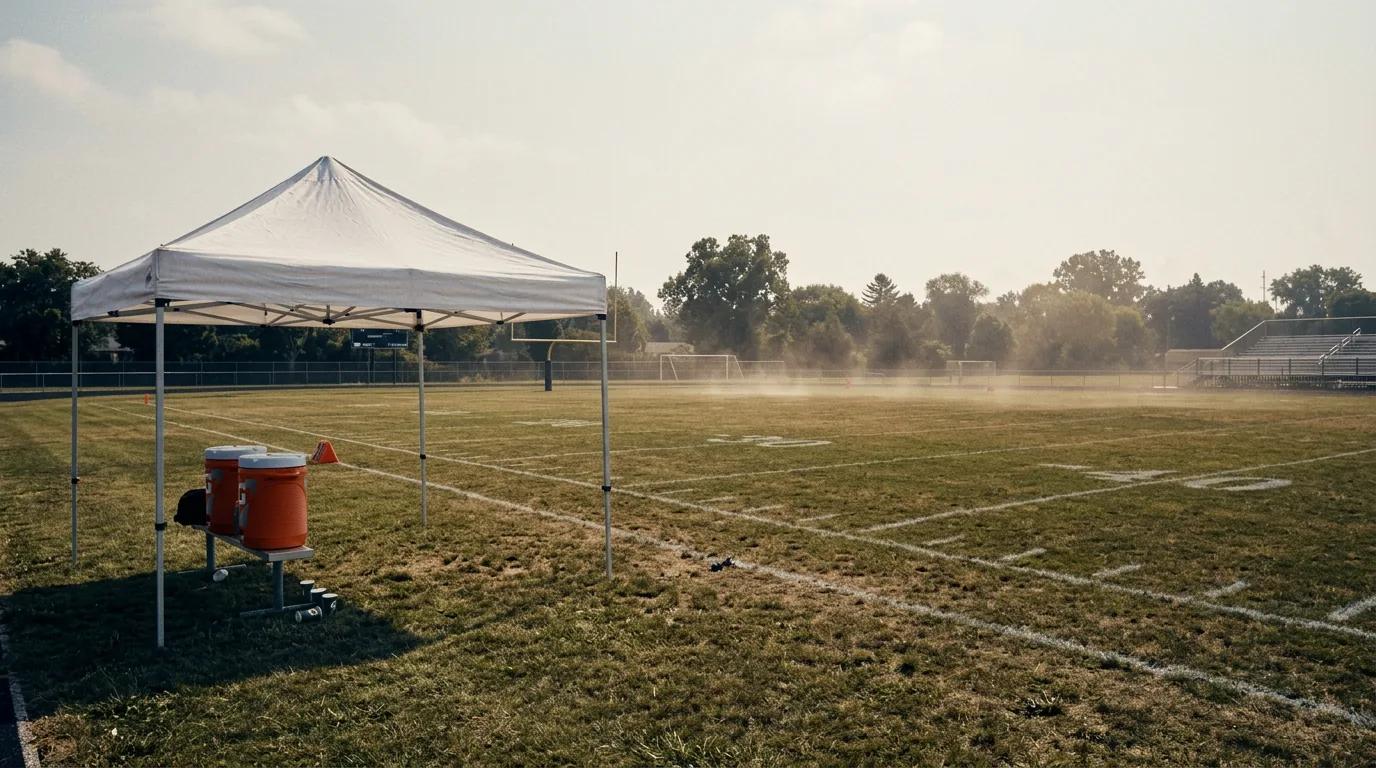
5:45 pm · The reading that decides the day
The level you land in sets the hours, the recovery and the pads.
Flash heat outlook for the practice field: heat index 98 by 3 pm and 101 by 4 pm, the warning level. The athletic director flags the football session.
Decision: the WIAA says to postpone at this level, so practice moves to 6:30 pm. The bus, the trainers and the parents hear now, not at 3:45.
Within an hour of practice, the designated person runs the WIAA Heat Index Calculator: 96, the caution level. A 2-hour practice, helmets off when not in contact, recorded on the WIAA Heat Index Record.
Flash lightning alert: a strike is predicted inside the site radius within the next 60 minutes. The field clears.
Last strike inside the radius. Flash starts the all-clear timer.
All clear. Practice resumes for its remaining time; the alert log records who was warned, when, and when play returned.
What should the athletic director keep on file?
The WIAA can ask to inspect the heat index records kept at school. Keep these together so a question from the WIAA, the district or a parent is answered from one folder.
- The WIAA Heat Index Record for each sport at each level, on every day the actual heat index reached 85°F.
- Any practice modification made, recorded with the reading that triggered it.
- Who the designated person is, and the time each reading was taken against the practice start.
- The rapid cooling method on hand — ice water immersion or TACO — at practices and events from a heat index of 70°F.
- The Flash alert log: lightning alerts, who was notified, the all-clear, and the outlook the schedule decision was based on.
Which other states publish WBGT policies?
Every state page follows this template: verified thresholds, the reading cadence, what to keep on file, and where the WBGT forecast fits.

State by state
Same instrument, different bands — the WBGT forecast travels with you.
- Georgia (GHSA)
- Texas (UIL)
- Florida (FHSAA)
- Arizona (AIA)
- Arkansas (AAA)
- Colorado (CHSAA)
- Hawaii (HHSAA)
- Illinois (IHSA)
- Kansas (KSHSAA)
- Massachusetts (MIAA)
- Mississippi (MHSAA)
- Missouri (MSHSAA)
- Nevada (NIAA)
- New Hampshire (NHIAA)
- New Mexico (NMAA)
- North Carolina (NCHSAA)
- Ohio (OHSAA)
- West Virginia (WVSSAC)
- Oklahoma (OSSAA)
- Alabama (AHSAA)
- California (CIF)
- Connecticut (CIAC)
- Iowa (IHSAA / IGHSAU)
- Kentucky (KHSAA)
- Louisiana (LHSAA)
- Minnesota (MSHSL)
- Nebraska (NSAA)
- New Jersey (NJSIAA)
- New York (NYSPHSAA)
- South Carolina (SCHSL)
- South Dakota (SDHSAA)
- Utah (UHSAA)
- Vermont (VPA)
- Virginia (VHSL)
- Wisconsin (WIAA)
Sources
- WIAA — Health & Wellness: Heat Index Policy, Heat Index Calculator and Practice Model (WIAA Handbook, Executive Board Policies, revised 2020). Checked 15 Oct 2026.wiaa.com/health-wellness/ (opens in a new tab)
WIAA documents are published at wiaa.com (opens in a new tab).
Frequently asked
No. The WIAA policy runs on the heat index from its own Heat Index Calculator, which uses AccuWeather data for a city or ZIP code. The WIAA recommends that schools use its calculator and no other site.
On days when the forecast heat index is 85°F or higher, check within one hour of each practice. If the actual heat index is 85°F or higher, record it on the WIAA Heat Index Record, one record per sport per level.
No. The WIAA policy is applied to the calculator's reading. Flash's outlook tells you earlier in the day where the heat is heading, so the schedule decision is made before the reading is due.