Why Flash · Everyone else vs Flash · Prediction, not detection
Flash vs lightning detection, side by side.
Detection tools tell you where lightning was. Flash tells you where it will be, up to an hour before, one kilometre at a time. That is the difference between reacting and deciding. No vendor is named on this page: the left column is what detection-based tools and hourly forecasts do by design.
- DETECTS · AFTER
- PREDICTS · UP TO 60 MIN BEFORE
For golf, construction, sports, schools, roofing and agriculture. Nothing to install. No vendor is named on this page.
- Lead time
- EVERYONE ELSEAlerts on strikes already located, or one hourly forecast
- FLASHUp to 60 minutes ahead, predicted per 1×1 km cell
- Resolution
- EVERYONE ELSEOne answer for every site in the county
- FLASH1×1 km: each site gets its own cell and its own answer
- Refresh
- EVERYONE ELSEHourly, or whenever the next strike lands
- FLASHEvery 2 minutes for lightning, every 5 minutes for hail
- Hardware
- EVERYONE ELSESensors, masts or sirens to install, power and lease
- FLASHNone. Web app, mobile app, API, SMS and horn relays
Capability by capability
Which does what? Everyone else and Flash, side by side.
Left column: what detection-based lightning tools and hourly forecasts do by design. Right column: what Flash does, with the numbers published on flashweather.ai.
Illustrative example · Not live weather
| Capability | Everyone else |  |
|---|---|---|
| Alert timing | Comparison 1 of 5 Detects lightning once it's already here The first alert is the first strike. | Predicts it up to an hour before it strikes Every cell is scored 60 minutes out, so the call is made early. |
| Resolution | Comparison 2 of 5 County-level forecasts One answer for every site in the county. | 1×1 km, field-level precision Each site gets its own cell and its own answer. |
| Refresh rate | Comparison 3 of 5 Updated hourly, or slower The storm moves faster than the map. | Refreshed every 2 minutes The map moves with the storm, not behind it. |
| Forecast | Comparison 4 of 5 “Chance of storms this afternoon” A percentage and a shrug. | “Lightning reaches this field at 3:47” A place, a time, a decision. |
| Decision | Comparison 5 of 5 React and hope Clear the field after the first flash. | Decide with confidence A GO or NO-GO with the time attached, and a log to prove it. |
5 calls · tap or swipe to explore
Generic comparison with detection-based tools. No vendor named. Named vendors, compared
The hour before
A detection alert starts its clock at the first strike. Flash starts yours up to 60 minutes earlier.
The clock
Where each alert sits on the clock
Detection can only report a strike after it has been located. Flash flags the cell in the hour before it. Both are useful; only one of them gives you time.
Detection-based tools
The first alert is the first strike. A sensor network locates a cloud-to-ground strike seconds after it happens and tells you whether it fell inside a radius you set. Precise about the past, silent about the next hour.
On site, that means
You clear the field after the first flash, and the return-to-play clock starts from a strike that has already landed.
Flash · Prediction
Every 1×1 km cell carries a forecast for the coming hour, refreshed every 2 minutes. When a cell is flagged, the crew, the tee sheet and the safety officer get the call before the first strike, with a time attached.
On site, that means
You decide with up to 60 minutes in hand, log the decision, and still see detected strikes on the same map when they come.
Honest answer
When is a detection-based tool the better fit?
Three cases where we would tell you to keep the sensor, and what Flash does beside it.
Your written policy names an on-site device.
If your state or conference policy requires a sideline WBGT reading or a field-meter alarm, keep the device the policy names. Flash runs beside it for the hour before a storm and for the heat-planning outlook; it does not replace the reading.
You only need confirmation.
If the job is to confirm that a strike happened inside a radius and start the return-to-play clock, a detection feed does that well. Flash shows detected strikes on the same map, so the two never disagree about what happened.
You want one vendor for hardware and app.
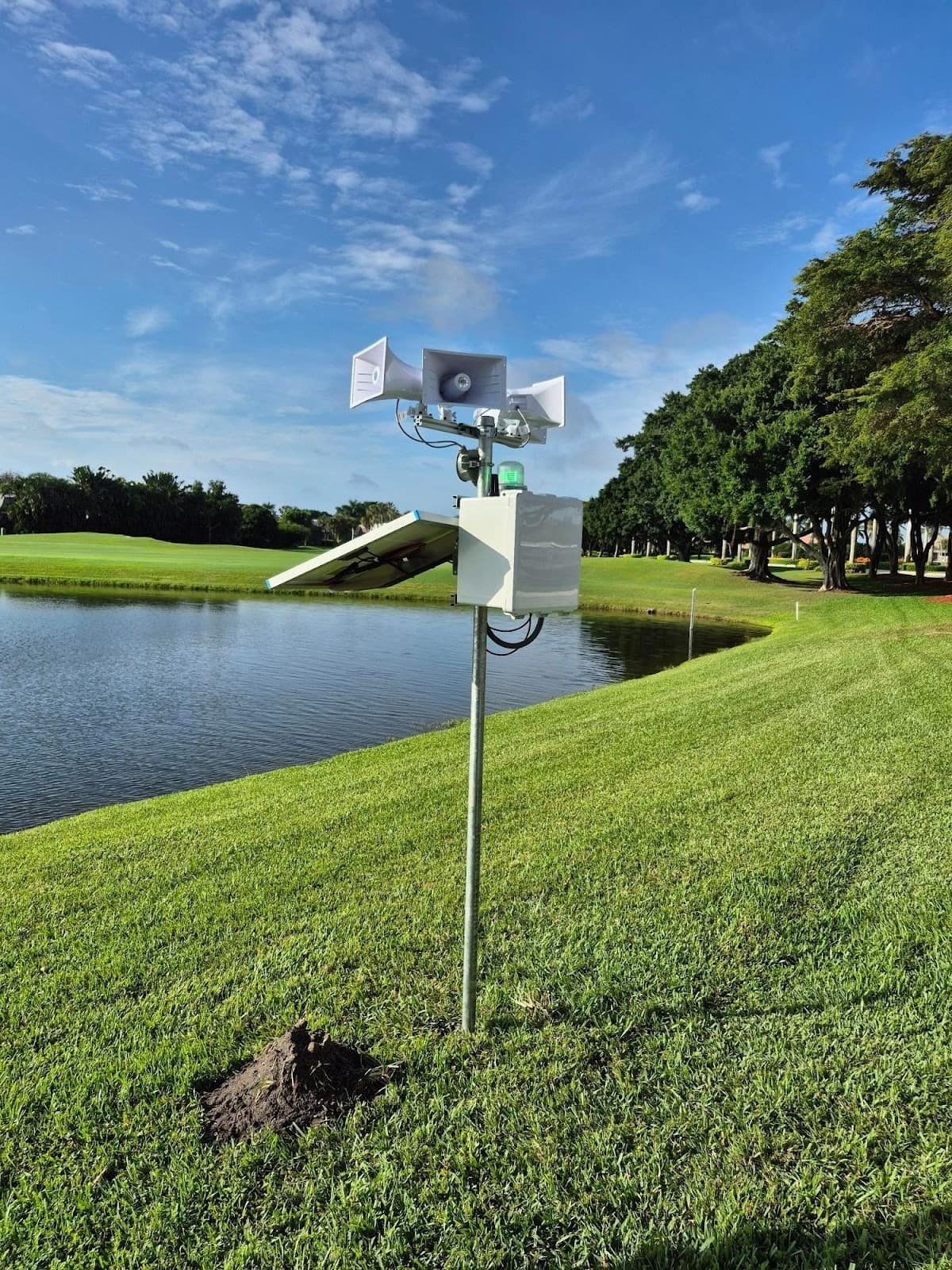
Some tools bundle a station, sirens and software in one lease. Flash is software first: it drives the horns and strobes you already own through relays, and Flash Weather Shield adds a predictive siren on site where you want one.
Your options
Detection, prediction or do it yourself: which one fits your site?
Start here: Flash Weather
- Start here
Flash Weather
FITS WHEN
You need to act before the first strike across one site or hundreds, with nothing to install: prediction up to 60 minutes ahead per 1×1 km cell, refreshed every 2 minutes, with a published accuracy method.
WATCH FOR
No on-site WBGT probe. Where policy requires one, run a sideline device beside Flash.
Detection-only tools
FITS WHEN
You only need confirmation that lightning has occurred within a radius, and a return-to-play clock that starts from the last strike. Often the cheapest feed to run.
WATCH FOR
The first strike is the trigger, so the alert follows it. Your radius rule decides how often you stop for storms that never reach you.
Do it yourself: public radar and a handheld WBGT
FITS WHEN
Budgets are tight and one trained person can watch radar, take readings and make the call for a single site.
WATCH FOR
No written alert log, no lead time, and every decision depends on who is on duty that afternoon.
The agentic approach
Everyone else vs the agentic approach
A dashboard, whoever makes it, still needs someone to open it, read the alert and make the call.
Ask
“Which of my sites has a lightning Watch before Sunday’s tee times?”
Answer
From the same 1×1 km cells, refreshed every 2 minutes.
Act
Moves practice, flags the tee sheet, reschedules the lift. Confirmed by a person.
How this page is written
How we keep this comparison honest
No vendor is named on this page. “Everyone else” means the two things most operations run today: a detection-based lightning tool that alerts on strikes already located, and an hourly forecast issued for a county or a city. The left column describes what those do by design, not what any one product promises.
Every Flash figure on this page comes from flashweather.ai and is defined on the Accuracy Method page: what is scored, on what window and against what ground truth. The clock times in the table are illustrative, not live weather.
If you build a detection tool and think a row is unfair, write to support@flashweather.ai. We will read it, and change the row if it is wrong.
- FLASH FIGURES
- Defined and scored in the accuracy method · product specifications on Lightning Prediction and Hail PredictionScored · see method
- EVERYONE ELSE
- Described by category only: detection-based tools and hourly forecasts. No vendor’s page is quoted.No vendor named
FAQ
Questions buyers ask before choosing between detection and prediction
Detection has almost none for strikes that have already happened, because it reports the past. Prediction is a forecast, so it is scored like one: Flash publishes how each 1×1 km cell is scored on the one-hour window, against an independent record of cloud-to-ground strikes, on the Accuracy Method page.
No. Detection reports a strike that has happened; prediction forecasts where a strike is likely in the next 60 minutes. Flash shows both on one map. The prediction vs sensors vs detection explainer walks through the three technologies.
No. Flash is software: web app, mobile app, API, SMS and email, and relays for horns or strobes you already own. If your policy requires an on-site WBGT device, keep it and run Flash beside it.
Yes, and we recommend it. Detection confirms the strike and anchors your return-to-play clock; Flash gives you the hour before it. Skye, Flash Weather’s AI weather agent, answers from the same cells and acts in the tools you already run.