Skip to content
Irrigated crop rows under dawn frost mist in low golden light, with Flash’s example field readings for frost, evapotranspiration, dollar spot pressure and growing-degree days

AGRICULTURE & TURF · FLASH AGRONOMY SUITE

Frost, evapotranspiration, disease pressure and growing-degree days at 1×1 km — the Agronomy Suite from the Turf Threat Tracker acquisition.

The Turf Threat Tracker models now run on Flash’s 1×1 km grid alongside hail and lightning prediction. Golf course superintendents, directors of agronomy, and turfgrass, field and athletic facility managers get the forecasts in the Flash web app, mobile app and API.

Delivered in the Flash web app, mobile app and API · continental U.S. · no sensors required for the forecast

  • FROST · FIELD 4 · 03:4031 °Falert issued the evening before
  • ET · TODAY4.2 mmirrigation replacement 4.6 mm
  • DOLLAR SPOT · 72 Hindex 71high pressure, preventive window open
  • GDD · BASE 50 °F1,284cumulative since 1 Mar

ILLUSTRATIVE EXAMPLE · NOT LIVE WEATHER

Skye · ask in plain language

Ask the question your crew actually asks.

Pick your industry. Skye, Flash Weather's AI weather agent, answers from the same 1×1 km forecast, refreshed as often as every two minutes, then acts in the tools you already run.

SKYE can connect to your CRM and ERP.

Your tools and data

Sites, limits, schedules

CRM · ERP · Procore · Slack

Prediction engine

15+ forecasts, 1×1 km

Lightning every 2 min, hail every 5

Power
Skye, the Flash Weather agent

Skye

Combines both, answers in plain language, proposes the action.

You and your crew

Ask in plain language

Get the answer in seconds

Your decision

  • Go / No-go
  • Reschedule
  • Alert the crew
Pick your industry

Questions crews ask

Illustrative example · not live weather

Agronomy weather forecasting at 1×1 km: 20+ site-specific metrics on one grid

Each model runs per 1×1 km cell for every field, green or block you register, and every output lands in the same alert list your crews already use for lightning.

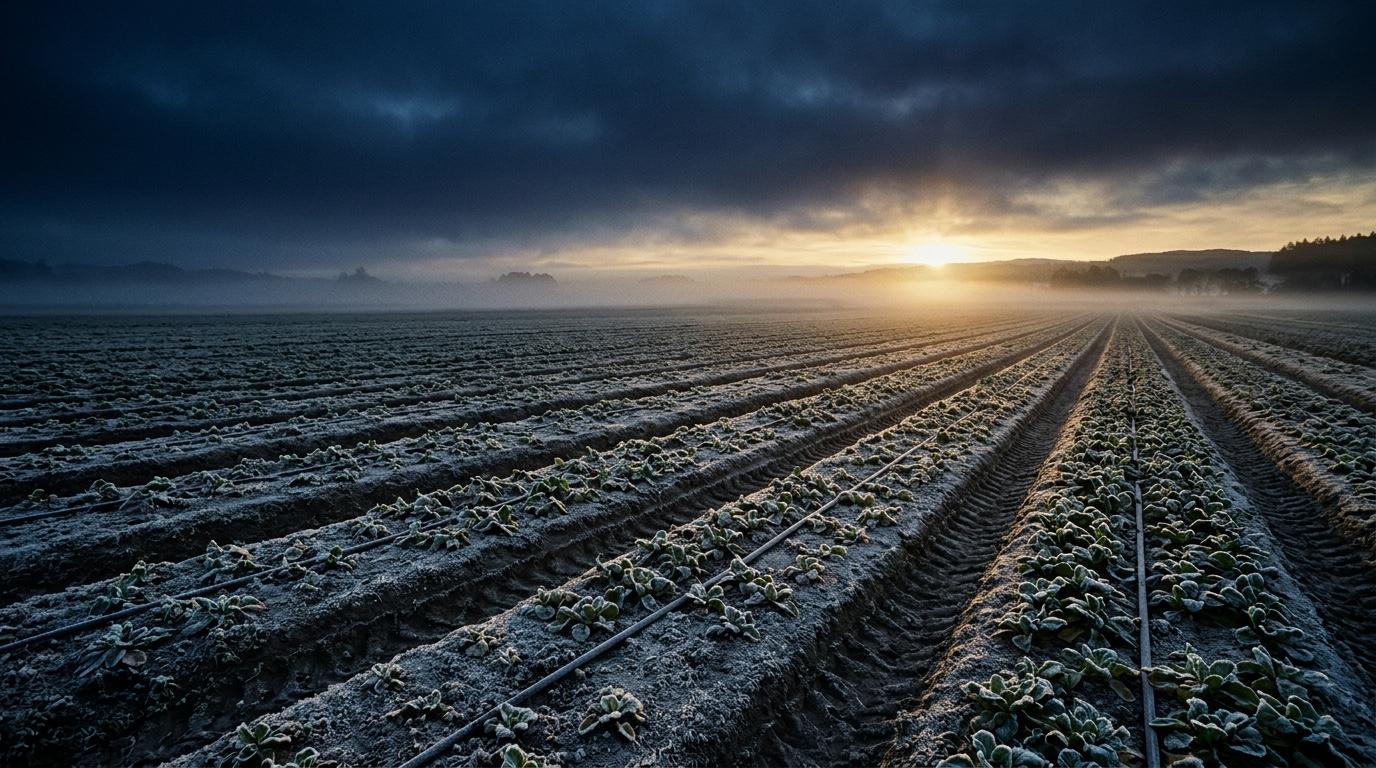
  • Hoarfrost crystals edging young crop leaves at first light above frozen soil, the condition Flash’s frost alert predicts hours ahead

    FORECAST 01

    Frost alert

    32 °F · hours ahead

    Hours-ahead notice when a cell is forecast to cross your frost threshold, with the expected low and its time.

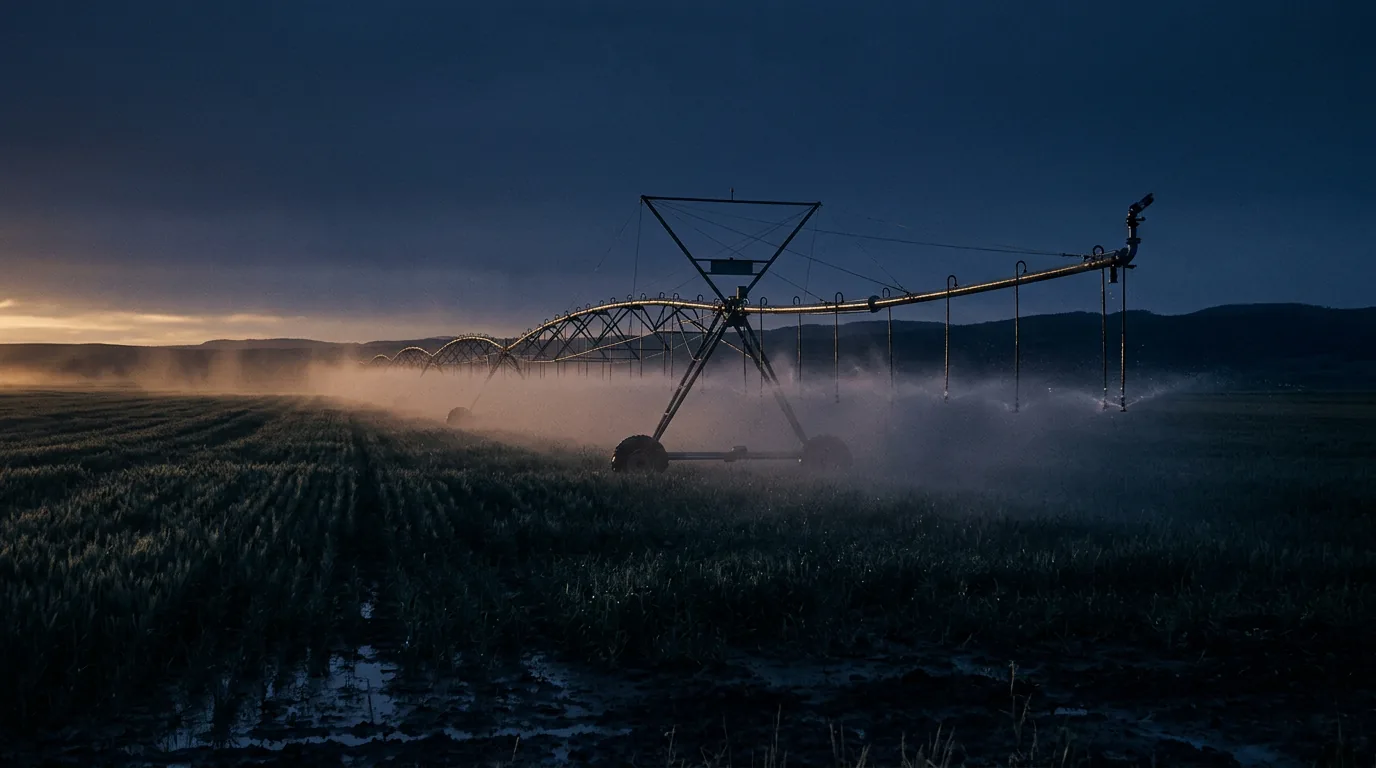
  • A center-pivot irrigation boom throwing fine spray across a field at dawn, the mist catching low light

    FORECAST 02

    ET & irrigation

    daily mm · multi-day outlook

    Reference evapotranspiration per cell and the replacement depth to schedule, so you water to the forecast, not the calendar.

  • Heavy dew beading on close-cut turf at dawn with ground fog over the fairway, the leaf wetness that drives disease pressure

    FORECAST 03

    Disease forecasting

    pressure index per cell

    Dollar spot, pythium and brown patch pressure from leaf wetness, humidity and temperature history, forecast for the days ahead.

  • Rows of young crops running to the horizon as the sun rises through low mist, the growing season Flash’s GDD tracker counts

    FORECAST 04 · AGRONOMY SUITE

    GDD tracker

    base 50 °F · cumulative

    Growing-degree days accumulated per cell from your start date, with the forecast days added so you time growth regulators and seedhead control.

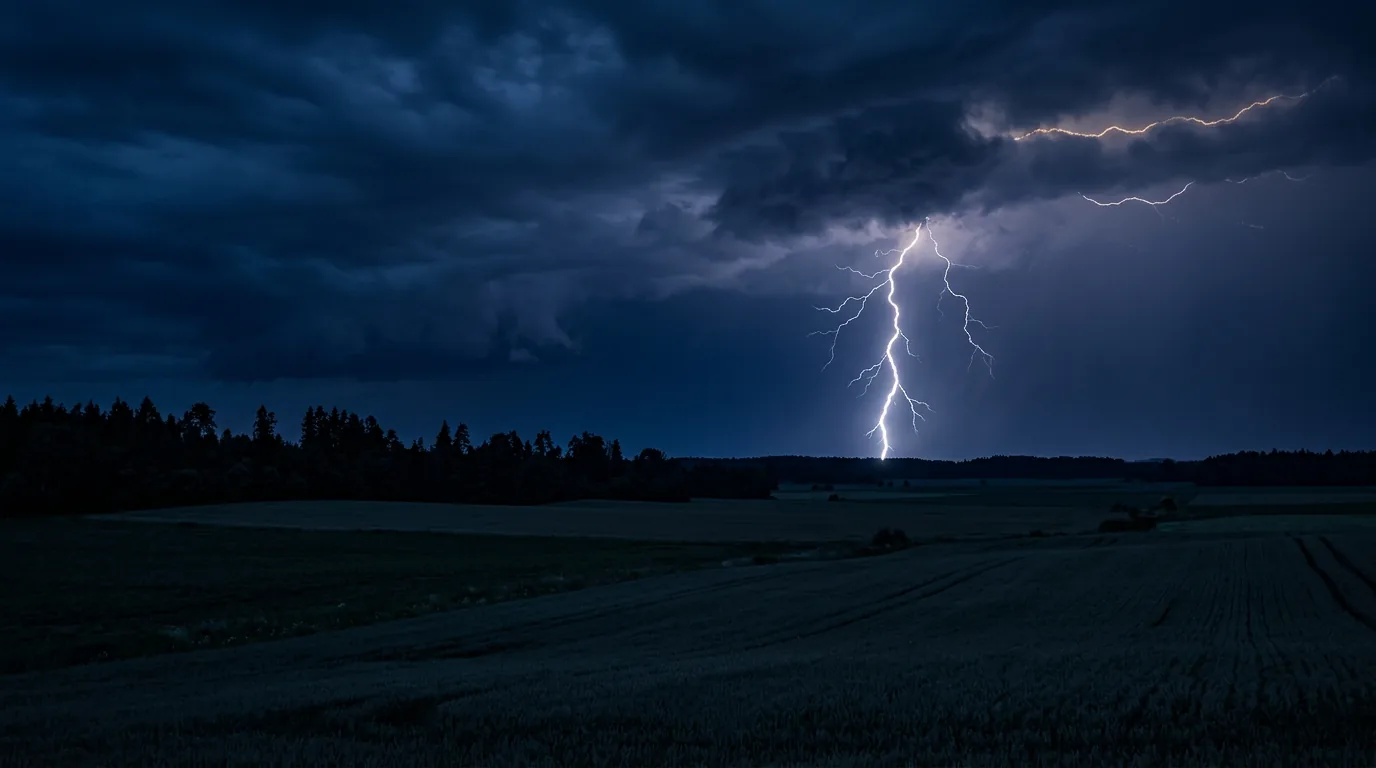
  • A lightning bolt striking beyond a treeline under a dark storm sky over open farmland, the strike a spray or harvest crew clears the field ahead of

    FORECAST 05 · LIGHTNING SUITE

    Hail & lightning for field crews

    Up to 60 min · 55 min ahead

    FirstStrike and Predictive Hail on the same cells, so a spray crew or harvest crew clears the field before the strike or the stones arrive.

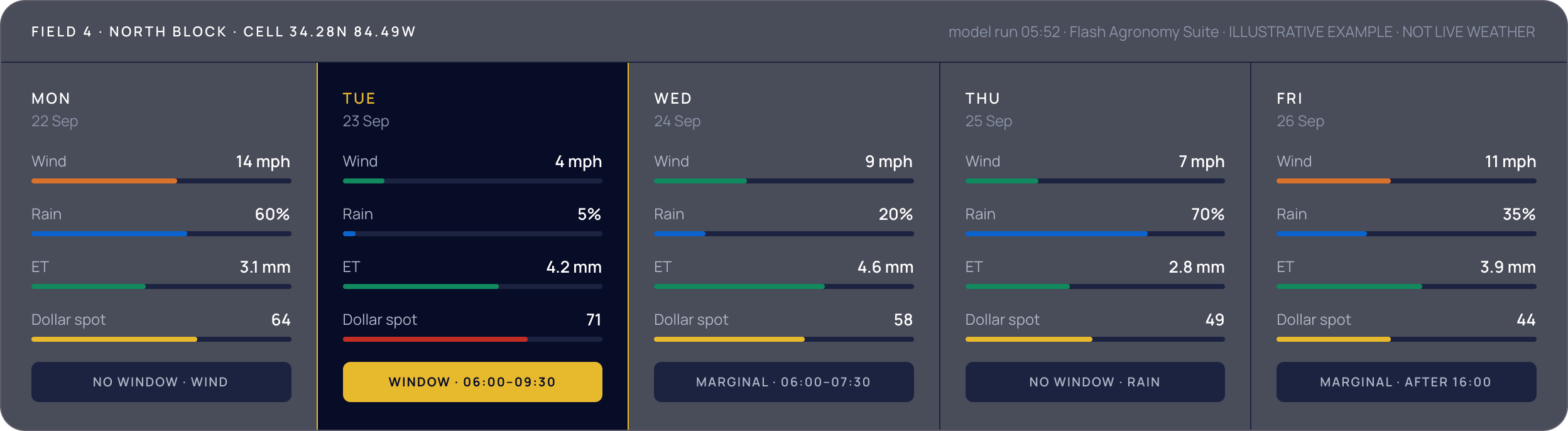
Spray-window planner: five days, one field, one answer

Wind, rain probability, evapotranspiration and disease pressure for one 1×1 km cell, so the agronomist books the sprayer for the hours that will actually work.

  • spray window
  • wind above 10 mph
  • rain probability
Flash Agronomy Suite spray-window planner showing five days of wind, rain probability, evapotranspiration and disease pressure for one 1×1 km field cell, with Tuesday 06:00–09:30 highlighted as the spray window

ILLUSTRATIVE EXAMPLE · NOT LIVE WEATHER

Which model matters when: the agronomy calendar

Southeastern turf and row-crop season shown; Flash shifts the windows to your latitude and your start date.

ILLUSTRATIVE EXAMPLE · NOT LIVE WEATHER

Twelve-month calendar strip showing when Flash’s frost, ET, disease-pressure, GDD and hail-lightning models are active in a southeastern turf season
JANFEBMARAPRMAYJUNJULAUGSEPOCTNOVDEC
Frost alertoffactiveactiveactiveoffoffoffoffoffactiveactiveoff
ET & irrigationoffoffoffactiveactiveactiveactiveactiveactiveoffoffoff
Disease pressureoffoffoffoffactiveactiveactiveactiveactiveoffoffoff
GDD trackeroffoffactiveactiveactiveactiveactiveactiveactiveactiveoffoff
Hail & lightningoffoffactiveactiveactiveactiveactiveactiveactiveactiveoffoff
  • SPRING · MAR–MAY

    Frost on new growth

    Radiational frost on clear, calm nights after green-up. The frost alert names the cell, the expected low and the hour; bloom, seedings and sod are the exposure. GDD accumulation starts.

  • SUMMER · JUN–AUG

    Disease pressure and ET

    Dollar spot, pythium and brown patch pressure climb with warm nights and leaf wetness; ET peaks and irrigation replacement is scheduled to the forecast, not the clock.

  • FALL · SEP–NOV

    GDD, harvest and overseeding

    Cumulative GDD times growth regulators and seedhead control; harvest and overseeding windows come from rain probability and wind, and the first frost alert of the season closes the cycle.

  • WINTER · DEC–FEB

    Planning from the record

    Season summaries per field: frost nights, disease-pressure days, ET totals and final GDD, exported for next year’s budget and program planning.

Syngenta and the Turf Threat Tracker acquisition

Two names come up in every agronomy conversation with Flash. Here is exactly what each one is, so you do not have to leave this page to find out.

  • A close-cut golf green with fresh mower stripes under dawn ground fog, dew on the turf and the treeline in silhouette

    Lightning prediction, delivered through the Flash API

    SYNGENTA · API LIGHTNING PROVIDER

    Flash is the API lightning provider for Syngenta

    • Disease-pressure index and spray windows per 1×1 km cell
    • GDD tracking for growth-regulator timing, per green or per field
    • Frost and ET on the same 1×1 km grid as Flash’s hail and lightning prediction
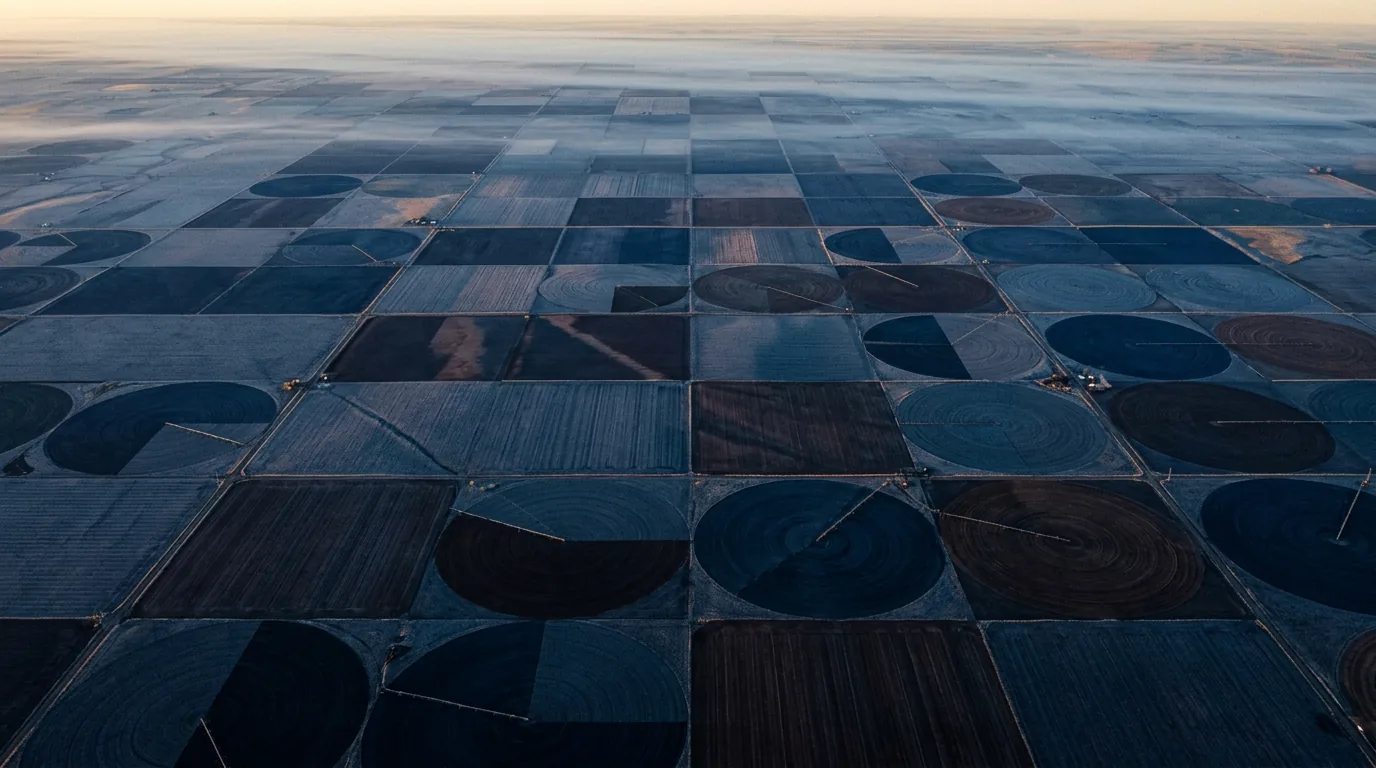
  • An aerial view of a patchwork of square farm fields and irrigation circles under dawn frost mist, echoing the 1×1 km forecast grid

    Agronomy models on the same 1×1 km grid as hail and lightning

    TURF THREAT TRACKER · ACQUISITION

    The models came with the acquisition, and got a bigger grid

    Flash acquired Turf Threat Tracker. Its frost, evapotranspiration, disease-forecasting and growing-degree-day models now run on Flash’s 1×1 km grid as the Flash Agronomy Suite, fed by the same 30+ integrated data signals as FirstStrike and Predictive Hail, across the continental U.S.

    • Existing Turf Threat Tracker accounts moved to Flash logins with their field histories intact
    • Agronomy Suite sold on its own or alongside Lightning and Hail Prediction
    • Full partner list, coverage and acquisition notes on the press and partners page

FEATURES & PODCASTS

The Agronomy Suite, covered by the turf press: the two acquisition stories and two long interviews with Garrett Bastardi.

All coverage on press & partners →

OutdoorCoffeeShop also interviewed Garrett Bastardi on turf-focused intelligence. (opens in a new tab) (opens in a new tab)

60 minlightning, up to

55 minhail, up to

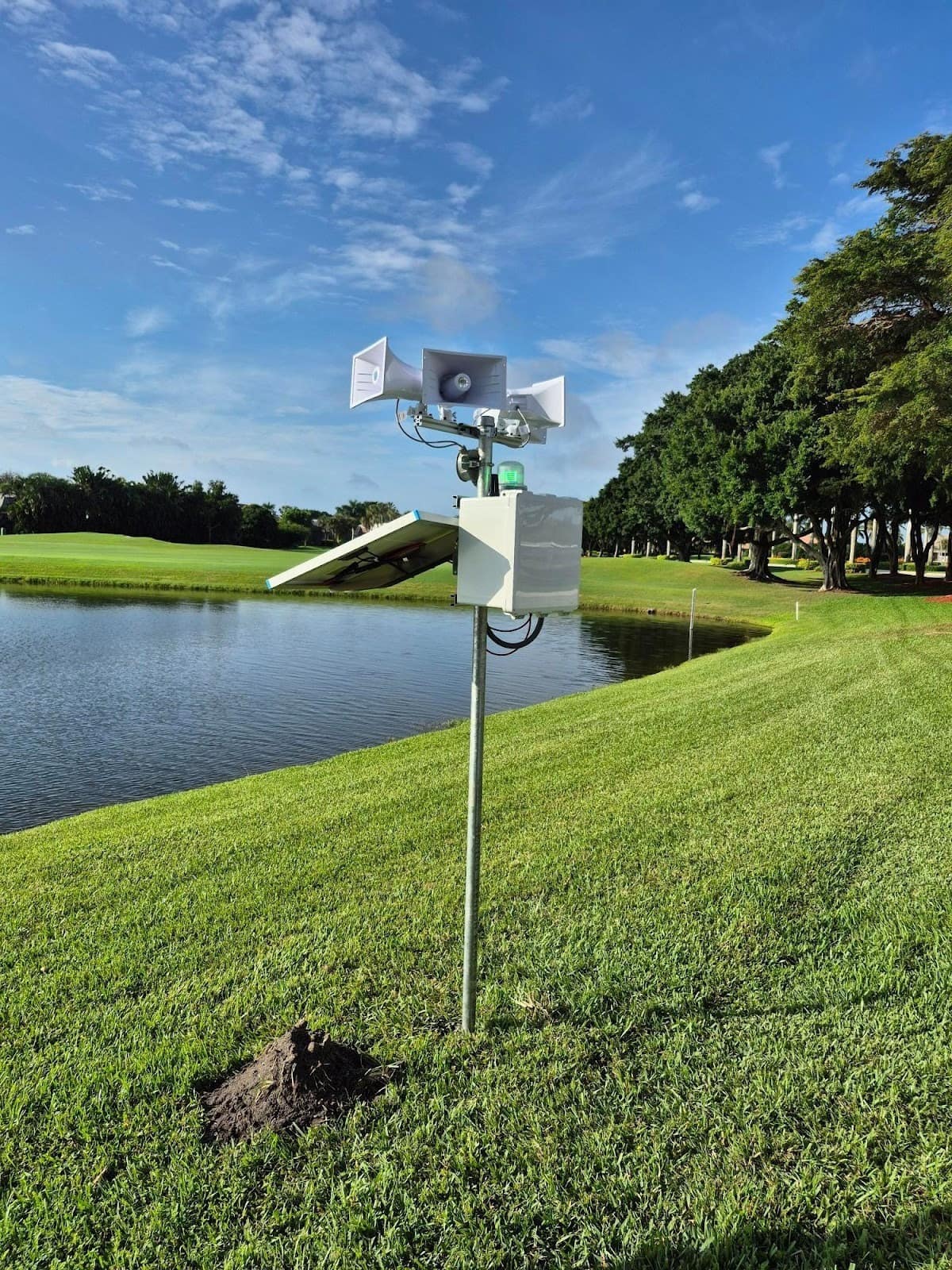
Flash Weather Shield siren installed on a golf course

Flash Weather Shield · predictive siren on site

Field-crew safety on the same cells as the agronomy models

Spray crews, harvest crews and irrigation techs get the same FirstStrike and Predictive Hail pull-off alerts that golf and construction customers use, by SMS and mobile push, for the exact 1×1 km cells they are working in. Lightning refreshes every 2 minutes, hail every five minutes.

Who brings Flash into agriculture, and why

The titles that make the call, the problem they describe on the first conversation, and where they gather.

Who buys

  • Golf course superintendent
  • Field manager
  • Turfgrass manager
  • Athletic facility manager
  • Director of Agronomy

The problem on the first call

  • Frost: which mornings carry it, and when it clears.
  • Heat, on the crop and on the crew.
  • Finding spray and harvest windows that hold.

Customers we can name

  • SyngentaFlash is the official API lightning provider

Questions superintendents, directors of agronomy and turf managers ask

The disease models are turf models: dollar spot, pythium blight and brown patch on cool- and warm-season grasses. Frost, ET and GDD are crop-agnostic and run on turf, orchards, vineyards, vegetables and row crops; you set the base temperature and the thresholds per field.

From per-cell leaf wetness, relative humidity and air and canopy temperature over the preceding days, scored against published infection models for each pathogen and expressed as a pressure index with an outlook for the days ahead.

Daily ET and replacement depth are available through the Flash API and as a scheduled CSV export, and several controller platforms read them directly. Flash does not switch valves itself.

Per person, per month, by product: there is no acreage line. Put the people who need Agronomy Suite or Weather Command Center on the subscription and pay for them alone. The pricing page lists every price and has a calculator.

Live demo · No sensors required for the forecast

See your own sites on the map before the next storm.

We'll load your locations, replay last season's strikes against Flash's predictions, and show you the alert log your safety officer would have received.