Skip to content

Source of truth · Explainer

AI lightning prediction vs electrostatic sensors vs detection networks: what each can and can’t tell you.

Three technologies are sold under the word “lightning”. One reports a strike after it has happened, one reads the electric field at a single mast, and one forecasts where the next strike is likely. Here is what each measures, how far ahead it can see, and where it belongs in a safety plan.

Figure 1 · What each one actually sees
  • Detection network

    After

    Sensors triangulate a strike that has already happened. Output: a dot on the map, with a radius rule that decides when you stop.

  • Electrostatic field meter

    During

    One mast measures the electric field at one point. Output: a needle that rises as charge builds nearby, for any reason.

  • AI prediction · Flash

    Before

    A model turns 30+ integrated data signals into a forecast for each 1×1 km cell, up to 60 minutes out. Output: a cell that changes colour before the first strike.

Definitions

What does each technology actually measure?

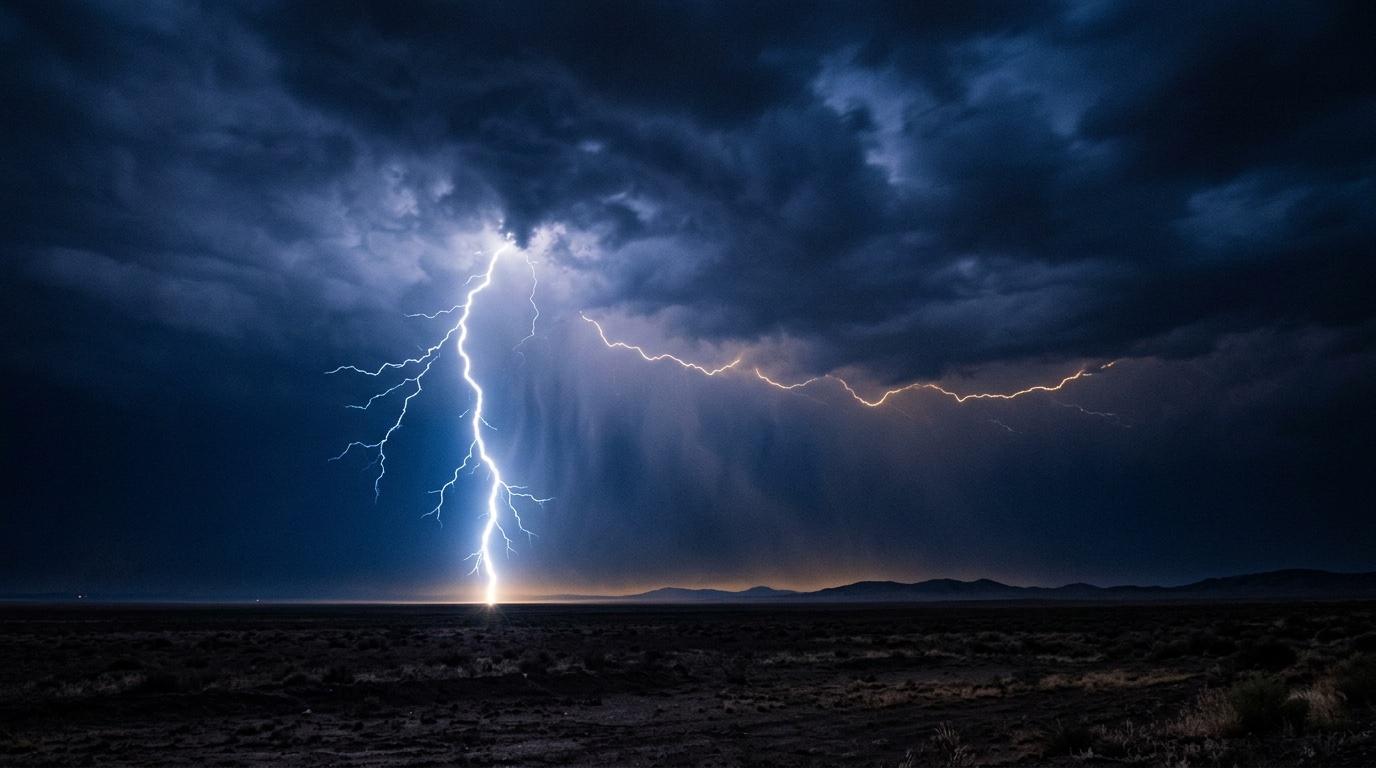
  • A cloud-to-ground lightning bolt striking open flat ground at night, illustrating what a detection network reports after the strike

    After the strike

    Detection network

    A national array of ground sensors listens for the electromagnetic pulse of a lightning return stroke and triangulates where it hit, usually within seconds. It is the reference record of what happened, and the kind of independent ground truth a forecast like Flash is scored against. A detection alert is precise about the past and silent about the next hour.

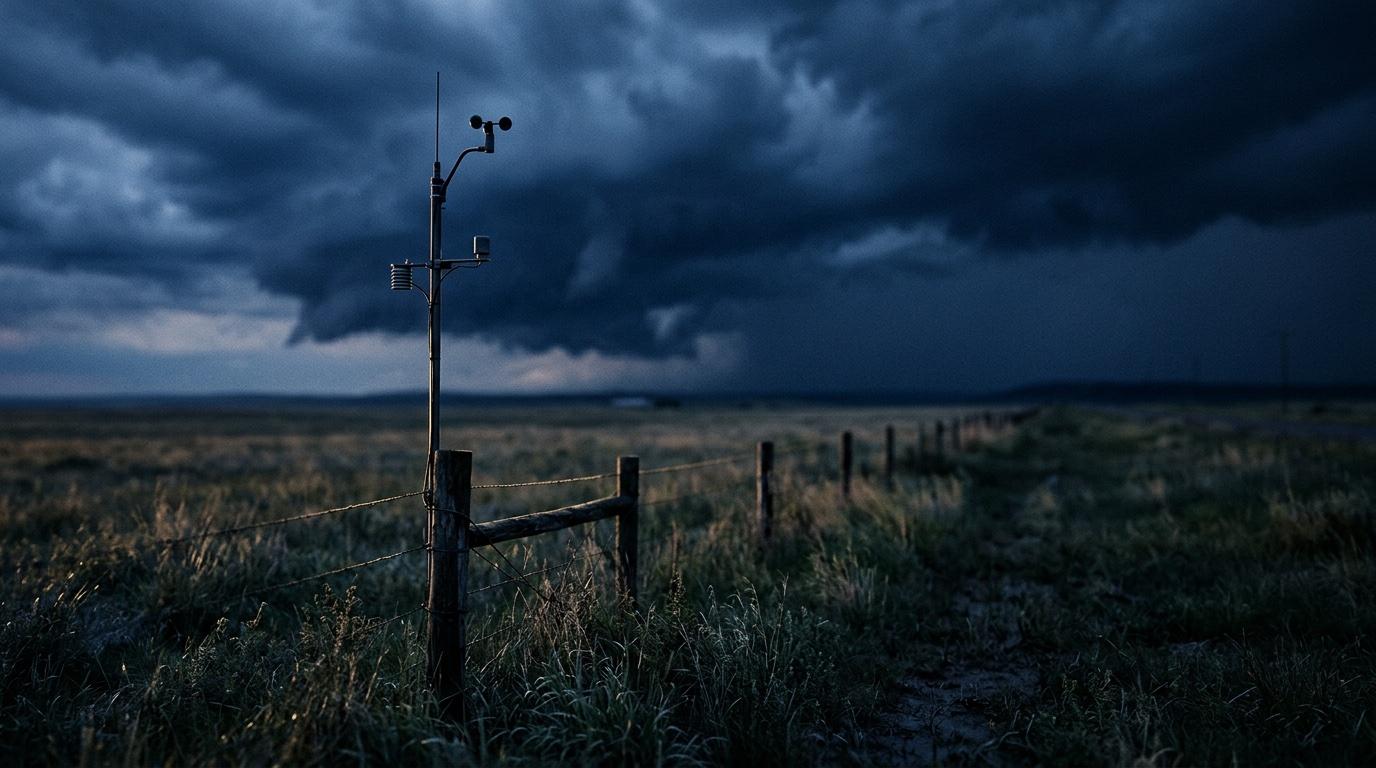
  • A single slender instrument mast on a fence line at the edge of an open field under a charged storm sky, illustrating an electrostatic field meter reading one point

    At one mast

    Electrostatic field meter

    A single mast measures the static electric field around one point and raises an alarm when the field climbs past a threshold. Because it reads charge rather than lightning, it can respond to a storm building overhead, and also to machinery, power lines and dust. It sees only its own surroundings, needs power and mounting at every site, and its warning time is whatever the local field allows.

  • A storm shelf cloud advancing over low rooftops before any lightning has struck, illustrating the hour AI prediction forecasts ahead of the first strike

    Before the strike

    AI prediction (Flash)

    Flash ingests 30+ integrated data signals and forecasts, for every 1×1 km cell, the likelihood of a cloud-to-ground strike in the next 60 minutes. It refreshes every 2 minutes and needs no on-site hardware. Its output is a forecast, so it is scored like one: hit or miss per cell on the one-hour window, against an independent ground truth, with the method published.

Side by side

How do they compare on lead time, false alarms and cost?

Detection network, electrostatic sensor and AI prediction (Flash) compared on what each measures, lead time, where it works, false-alarm behaviour, cost and install, and what each is best for.
Criterion
What it measuresThe electromagnetic pulse of a strike that has already occurred, located by triangulation across a national sensor network.The static electric field at one mast, over the few hundred metres around it.30+ integrated data signals, scored per 1×1 km cell.
Lead timeNone before the first strike. The alert follows the strike, within seconds.Vendor-stated warnings of several minutes; validation methods vary by product.Up to 60 minutes before a first strike, per 1×1 km cell, refreshed every 2 minutes.
Where it worksAnywhere the network covers; nothing at the site.Only around the mast. Each site needs its own unit, power and connectivity.Continental U.S.; any site you place on the map.
False-alarm behaviourVery low for strikes that happened. Your radius rule decides how often you stop for strikes that never reach you.Sensitive to local charge sources such as machinery and power lines: the basis of the “false alarm” caution in athletic-safety guidance.Scored per cell on the one-hour window against an independent ground truth; the method is published and the validation dataset can be requested.
Cost & installSubscription; sirens optional.Hardware purchase or lease per site, plus mast, mounting and maintenance.Software subscription, nothing to install; horn and strobe relays optional. See the pricing tiers.
Best forConfirming a strike and running your policy's return-to-play clock.Sites whose written policy names a field-meter alarm.Clearing the field before the first strike, across one site or hundreds.

Read this before you buy

Why does athletic-safety guidance warn about “lightning prediction” devices?

Position statements from athletic-training and collegiate sports-medicine bodies caution against relying on a single-point electrostatic “lightning prediction” device as the sole trigger for clearing a field. The reasoning is sound: a local field reading can rise for reasons other than an approaching storm, and it cannot see a cell that is outside its sensing range. That caution is about an instrument class.

Flash is a different category. It is a forecast model, not a field meter: it scores every 1×1 km cell on the one-hour window against an independent record of cloud-to-ground strikes, and publishes how that score is computed, what it covers and what it does not.

We recommend Flash alongside your detection feed and your written policy, not instead of them. If your policy names a detection radius or a sideline device, keep it. Flash gives you the 60 minutes before that rule fires.
Use them together

What should a safety officer actually run?

Not one or the other. Each does one job well, and a written policy can name all three.

  1. Before · The 60 minutes

    Flash prediction

    Per 1×1 km cell, refreshed every 2 minutes, up to 60 minutes ahead. Clear the field on Advisory or Warning, whichever your policy sets.

    On duty: Before the storm

    Glossary ↓ 1×1 km cell, Advisory · Watch · Warning

  2. During · Confirmation

    Detection feed

    Confirm each strike and start your return-to-play clock from the last one. Flash shows detected strikes on the same map.

    On duty: During the storm

    Glossary ↓ NLDN, Return-to-play

  3. On the sideline · Policy

    WBGT sensor

    Where your state requires an on-site reading, take it with the device the policy names. Flash carries the heat-planning outlook for the day.

    On duty: On the sideline, for policy

    Glossary ↓ WBGT

= one complete safety plan

Skye, Flash Weather's AI weather agent, answers from the same cells and acts in your tools.

See Skye 

Glossary

Terms you will meet in every lightning-safety policy

8 terms

NLDN
The National Lightning Detection Network: ground sensors across the continental U.S. that locate strikes by triangulation. The reference record most U.S. safety programmes use.
Cloud-to-ground (CG)
A lightning flash that reaches the ground. The only kind Flash forecasts and scores; intra-cloud flashes are excluded.
First strike
The first CG strike of a storm cell inside a given 1×1 km cell. Detection can only report it; prediction is scored on whether it flagged the cell first.
False-alarm ratio
Flagged cell-windows with no CG strike, divided by all flagged cell-windows. Tracked alongside the hit rate so a forecast cannot score well by flagging everything.
WBGT
Wet-bulb globe temperature: a heat-stress index combining temperature, humidity, wind and solar load. Some state policies require an on-site reading.
Return-to-play
The wait after the last detected strike before activity resumes. Its length is set by your policy; Flash shows detected strikes on the same map so the clock starts from the right one.
Advisory · Watch · Warning
Flash's three alert levels for a cell, in rising order of likelihood inside the one-hour window. Your written policy names the level that clears the field.
1×1 km cell
The 1×1 km grid square Flash forecasts. Every site sits in one cell, and every score on the Accuracy Method page is computed per cell.

FAQ

Questions safety officers ask about prediction, sensors and detection

No system predicts the exact strike point. Flash forecasts the likelihood that a 1×1 km cell sees a cloud-to-ground strike in the next 60 minutes, and scores that forecast against an independent ground truth: up to 99.6% accuracy on the one-hour window.

No. A field meter reads the charge at one mast. Flash reads 30+ integrated data signals across the whole grid, refreshes every 2 minutes and publishes how its accuracy is scored.

Keep it. Detection confirms the strike and anchors your return-to-play clock; Flash gives you the time before it. Flash shows detected strikes on the same map so the two never disagree about what happened.

The accuracy method publishes the ground truth, the unit of measure and how each cell is scored on the one-hour window, so you can read exactly what up to 99.6% means, why it is “up to”, and how to request the validation dataset.

Book a demo · No sensors required for the forecast

See your own sites on the map before the next storm.

We'll load your locations, replay last season's strikes against Flash's predictions, and show you the alert log your safety officer would have received.