In this article · 8 sections
Most weather apps forward alerts from a lightning detection network. That network is excellent at one thing: telling you, within seconds, that a cloud-to-ground strike has just happened and where. The word that matters is "happened".
The alert you got was for a strike that already happened
The first strike of a storm cell is on the ground before the first alert leaves the server. If that strike is inside your radius, the notification is a report, not a warning — and the people on the field learned about it from the sky. Apps that "warn" from detection apply a distance rule to those reports: a strike inside the radius you chose triggers the push. That works when a storm approaches from a distance. It fails when the cell builds overhead.
That is the gap this article is about: the difference between being told a strike occurred and being told one is coming. The rest of it explains what the three technologies you will be sold actually measure, how much lead time each can give, and how to check a vendor's accuracy claim before you sign anything.
How detection networks work
A detection network — NLDN is the reference in the United States, and the ground truth we score against — listens for the electromagnetic signature of a discharge. Several stations time-stamp the same pulse; the differences in arrival time fix the location. The result is a precise map of where a storm has been, updated as each strike lands.
Because the network reports what has already discharged, its lead time for the first strike at your site is zero. Its real value is in the minutes after: it confirms the storm is active, shows where the cell is tracking, and — through the all-clear rule the NWS still teaches — starts the clock for the all-clear. A detection feed is a superb record. It is not a forecast.
Why electrostatic "prediction" sensors are a different thing
An electric-field mill — the sensor some vendors sell as "prediction" — measures the atmospheric electric field at the point where it is mounted. A rising field means charge is building nearby, and the unit sounds when the field crosses a threshold. It is a real physical measurement, and it can fire before the first strike.
Its limits are physical too. It sees one point. It needs a mast, power, calibration and a clear site. The field can rise without a strike following, which is where its false alarms come from. And it has to be bought, installed and maintained at every site you want covered — for a district with many schools, that is a mast, a calibration schedule and a replacement plan at every one of them.
What AI prediction does
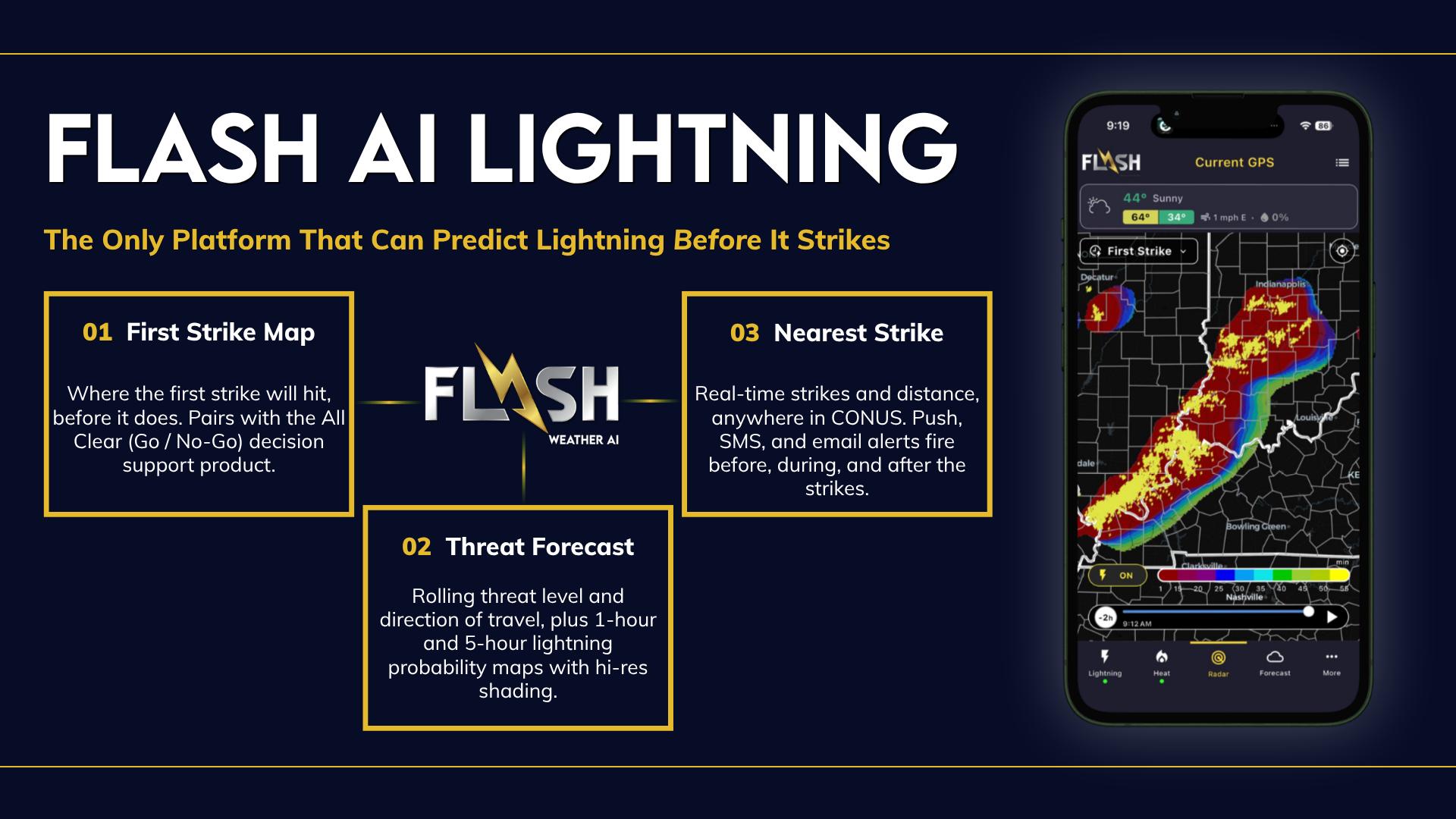
Flash starts from the other end. The prediction engine ingests 30+ integrated data signals — radar, satellite, surface observations, model fields — and distils them into 15+ proprietary prediction products for every 1×1 km cell across the continental U.S. The model re-runs every 2 minutes and outputs, per cell, the likelihood of a strike over the next 60 minutes, with a 5-hour lightning probability alongside. No mast, no site visit: your site is a pin on the map with a radius and a policy.
- 30+integrated data signals in
- 15+proprietary prediction products
- 1×1 kmgrid cell, refreshed every 2 min
- 60 minstrike-level prediction horizon
Measured against NLDN ground-truth strikes, the one-hour prediction window scores up to 99.6%. How hits, misses and the false-alarm ratio are counted is published on the accuracy method page with the arithmetic behind each one.
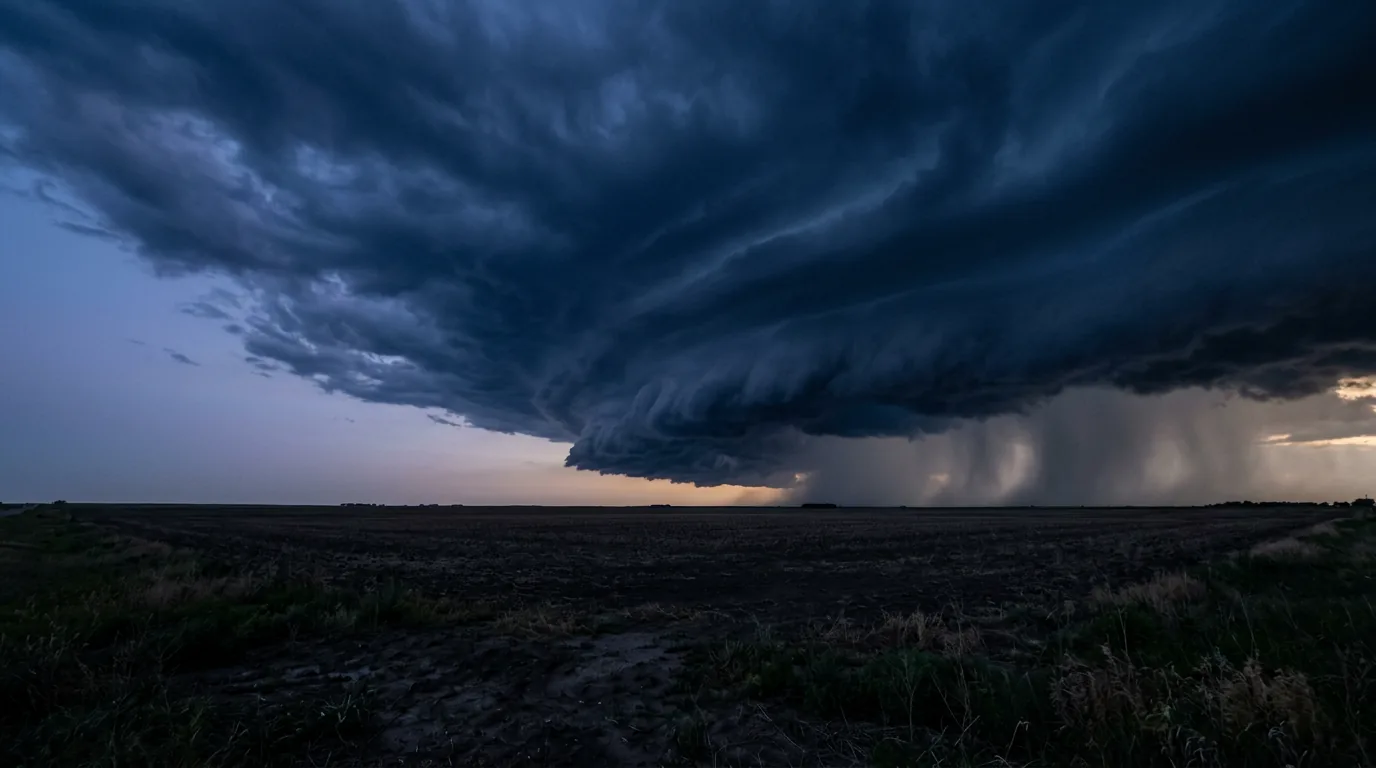
The hour before
A detection network has nothing to report here yet. A prediction does.
"Detection tells you where lightning has been. Prediction tells you where it is about to be. Only one of those is a decision you can still make."
Detection vs sensor vs prediction
| Attribute | Detection network | Electrostatic sensor | AI prediction (Flash) |
|---|---|---|---|
| Lead time | None for the first strike; confirms strikes after the fact | Minutes, at the mounted point, once the field rises | Up to 60 minutes per 1×1 km cell, refreshed every 2 minutes |
| What it measures | The radio pulse of a discharge that has occurred | The local electric field at one point | 30+ integrated data signals distilled into 15+ prediction products per cell |
| False alarms | Rare for strike reports; the "warning" is only a radius rule | The field can rise without a strike; site-dependent | False-alarm ratio published on the method page, with the arithmetic |
| Install | None on site; an app or a feed | Mast, power, calibration — one per site | None; software only, sites live in days |
Detection network
- Lead time
- None for the first strike; confirms strikes after the fact
- What it measures
- The radio pulse of a discharge that has occurred
- False alarms
- Rare for strike reports; the "warning" is only a radius rule
- Install
- None on site; an app or a feed
Electrostatic sensor
- Lead time
- Minutes, at the mounted point, once the field rises
- What it measures
- The local electric field at one point
- False alarms
- The field can rise without a strike; site-dependent
- Install
- Mast, power, calibration — one per site
AI prediction (Flash)
- Lead time
- Up to 60 minutes per 1×1 km cell, refreshed every 2 minutes
- What it measures
- 30+ integrated data signals distilled into 15+ prediction products per cell
- False alarms
- False-alarm ratio published on the method page, with the arithmetic
- Install
- None; software only, sites live in days
Troon, the Big 12, Syngenta and the NAIA
- Troon
- Flash is an approved vendor across all 700+ Troon golf properties. The extra minutes are the difference between a horn that clears the back nine in time and a horn that follows the strike.
- Big 12
- Flash is the official weather safety provider of the Big 12 Conference.
- Syngenta
- Flash is the API lightning provider for Syngenta.
- NAIA
- Official Weather Monitoring & Alert System of the NAIA through October 2028.
How to check a vendor's accuracy claim
Every vendor will show you a percentage. Before you accept it, ask the four questions we answer for our own numbers on the accuracy method page.
- What is the window? A 60-minute prediction is a different claim from a claim with no stated horizon at all.
- What is the ground truth? We score against NLDN strikes. A claim scored against the vendor's own alerts is circular.
- What is the period? Ours is stated on the accuracy method page and restated each time the window moves.
- What are the misses? Ask for first-strike detection and false-alarm ratio, not just the headline percentage.
Frequently asked
Only if you accept zero lead time on the first strike. The app forwards a detection report and applies a radius; the first strike inside that radius is what triggers it.
Yes. The all-clear clock after the last strike is a return-to-play rule, not a detection rule. Prediction moves the first decision earlier; it does not shorten the all-clear.
No — it uses it. NLDN strikes are the ground truth every prediction is scored against, and confirmed strikes still drive the all-clear timer.
It depends on the storm: the model refreshes every 2 minutes, so the number for your cell updates as the cell develops. The median lead time is published on the accuracy method page.
Founder & CEO, Flash Weather
Founder of Flash Weather in Canton, Georgia, built to replace the "strike already happened" alert with one you can still act on. Reviewed against the Flash Accuracy Method on 21 Sep 2026.