FAQ · For buyers · 18 answers, 9 objections
The questions safety managers, athletic directors and superintendents actually ask — answered straight.
Eighteen answers, organised by the objection behind them. Every answer links to the page that proves it: no unqualified numbers, no hardware to buy, no generic radius.
Prediction
Up to 60 minutes before the first strike
Is 'prediction' real, or marketing?
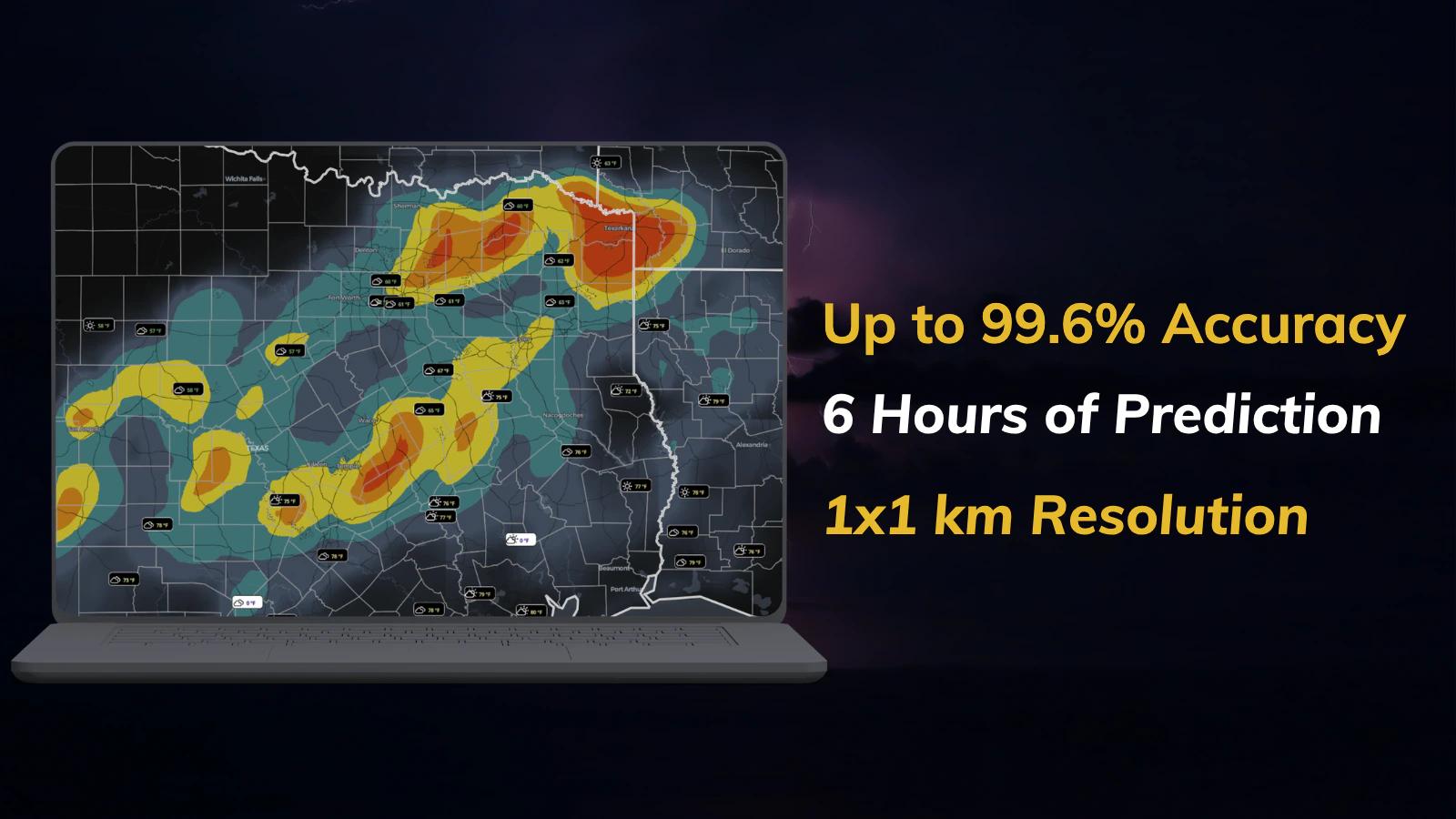
Short answer: real, up to 99.6% accurate on the one-hour window, and published with its method.
FirstStrike forecasts where lightning will strike up to 60 minutes before the first bolt, at 1×1 km resolution, refreshed every 2 minutes, with a 5-hour lightning probability outlook. A detection network can only tell you a strike has already happened; Flash tells you a cell is about to strike your site.
Up to 99.6% lightning prediction accuracy on the one-hour window, verified over five years across the contiguous U.S. against independent cloud-to-ground strike records. The accuracy method page shows how the number is computed and when it was last refreshed.
Because the hit rate moves with season and geography. In fall, winter and spring it reaches up to 99.6%; in summer, with air-mass thunderstorms, it is closer to 96%, and Florida and Colorado see that figure at times too. Flash updates every 2 minutes where traditional models update every one to six hours, which is why it rarely misses a 30-minute storm.

No hardware
Every site on the same 1×1 km grid
Sensors vs software: do I still need hardware?
Short answer: no hardware for lightning. Keep the on-site WBGT sensor your heat policy names.
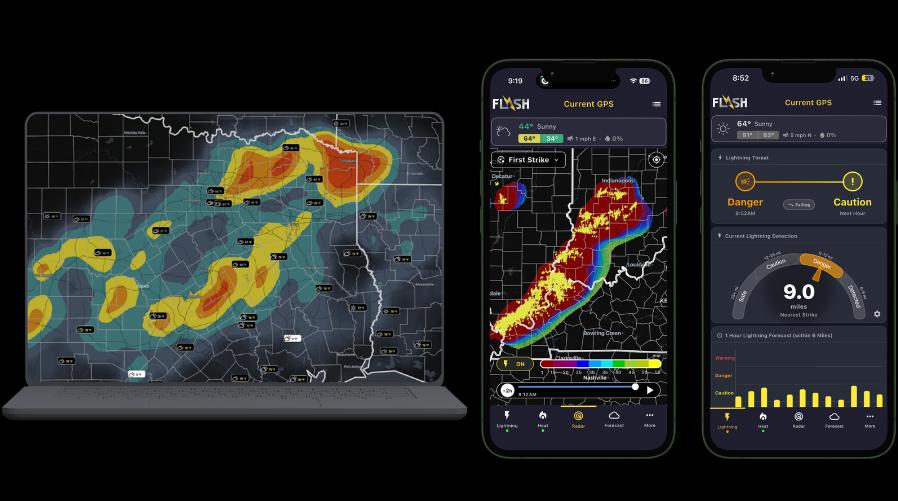
No. Flash is software only: web app, mobile app, API, SMS and email, plus horn and strobe integrations for the field. Coverage comes from 30+ integrated data signals across the continental U.S., not from a sensor you have to mount, power and calibrate.
Keep it if your policy names it. A detector confirms strikes that have already happened inside its range; Flash gives the warning up to 60 minutes before the first one. Most sites run Flash as the decision layer and keep the detector as a log of record.

Heat and WBGT
WBGT forecast
WBGT: forecast or on-site measurement?
Short answer: the forecast plans the day; the sensor on the field makes the call.
No, and we say so plainly. State heat policies move activity tiers on a wet-bulb globe temperature reading; Georgia's requires it to be taken on the field, and each state sets its own method. Flash forecasts WBGT so an athletic trainer can plan the practice window hours ahead; the reading your policy requires decides when the tier changes.
Scheduling. Trainers use the WBGT forecast to move an afternoon practice to the morning before the buses leave, and superintendents use it to plan crew rotations. When the on-site reading crosses a threshold, Flash logs the tier change next to the forecast it was measured against.

Consulting meteorology
Real meteorologists for your biggest days
Will I get a human meteorologist?
Short answer: yes. Flash Consulting Meteorology is led by former National Weather Service forecasters.
Yes. Flash Consulting Meteorology is led by founder Jason Deese, a former NOAA National Weather Service forecaster. Enterprise plans include storm-day desk support; any plan can add a written pre-event briefing.
That is what the desk is for. Send the venue, the schedule and your policy thresholds; the desk issues a written outlook the day before and monitors through the event.

Alert policy
Your radius, your lead time, your people
Can alerts follow my policy, not a generic radius?
Short answer: per-site thresholds, per-role delivery, horn and strobe, and a return-to-play timer that resets itself.
Yes. Each site carries its own thresholds: alert radius, lead time, WBGT tier and who is told. A superintendent, an athletic trainer and a safety manager can receive different alerts for the same cell. The return-to-play timer starts from the last strike and resets automatically if another one lands.
Yes. Horn and strobe controllers, SMS, email, mobile push and the API all fire from the same alert. You decide which channels each role gets and whether the all-clear is automatic or has to be acknowledged by a named person.
Audit file
Every alert, timestamped
What record do I have of each alert?
Short answer: a timestamped record of every alert, acknowledgement and decision.
A timestamped alert log: the prediction issued, when, to whom, who acknowledged it, what the on-site reading said and when the all-clear went out.
Yes. When a coach clears the field or a foreman calls a crew down, the acknowledgement is stamped against the alert that triggered it.
| Time | Event | Channel | Acknowledged |
|---|---|---|---|
| 15:42:10 | Prediction: first strike in 38 min, cell 1.8 mi NW | SMS · horn · app | Athletic trainer · 15:42:55 |
| 15:58:31 | Strike confirmed 0.9 mi · return-to-play timer started | app · dashboard | Automatic |
| 16:33:04 | All-clear issued · last strike 16:03:04 | horn · SMS | Athletic trainer · 16:33:40 |
Pricing
Screen, pocket and API
Pricing, contracts and pilots
Short answer: per person, per month for the platform, consulting by the year, and a pilot on your real sites before you sign.
Per person, per month. Weather Command Center, Agronomy Suite, Predictive Hail and Winter Weather Center are $10 per user a month and the Flash Mobile App is $3.99. Consulting meteorology is billed yearly, the Flash Weather Shield is priced on request, and Enterprise is quoted. The pricing page has a calculator.
Yes. A pilot loads your sites, replays last season's strikes against Flash's predictions and shows the alert log your team would have received. It runs on live weather at your real locations, not a demo account.

Hail and API
Up to 55 minutes before the first stone falls
Hail and the API
Short answer: hail size, timing and swath up to 55 minutes ahead, and every prediction available by API and webhook.
Predictive Hail predicts hail up to 55 minutes before the first stone falls, at 1×1 km resolution with updates every five minutes: hail size by class, timing down to the minute and a 1-hour swath prediction, built on four years of convective storm data across the CONUS.
Yes. The Flash API returns lightning and hail predictions for any 1×1 km cell, with over 100 parameters and forecasts out to 180 hours, and webhooks push alerts into dispatch, fleet-staging and claims tools. Carriers and fleet managers use it to move vehicles before a hail cell arrives.

Agentic
Ask in plain language; get an answer or an action
Can I just ask it?
Short answer: yes. Skye, Flash Weather’s AI weather agent, answers in plain language and acts in the tools you already run, with a human confirming any change.
Ask in plain language — "Which of my sites has a crane lift inside a lightning window this week?" — and Skye reads the forecast for your cells, answers with the cell and model run it used, and acts where you allowed it: moving a practice in Google Calendar, rescheduling a lift in Procore, or pushing a canvass list to HubSpot. It connects to Google Calendar, Microsoft 365, Salesforce, HubSpot, NetSuite and SAP, Procore, Slack and Teams, and webhooks. No command center to open.
Three guardrails. Permissions are set per connector, so the agent can read a calendar without being able to write to it. Every action is logged with the question, the cell and the model run behind it. Any change to a schedule or a record waits for a human to confirm.
Still on the old app questions?
Free vs premium, notifications and account questions for the Flash Mobile App now live in the app help centre. The old /faq/ address redirects here permanently (301), so nothing you bookmarked is lost.
Download the free app (opens in a new tab)