Predictive Hail predicts hail up to 55 minutes before it reaches a site, on 1×1 km cells refreshed every five minutes with timing down to the minute. Crews come off the roof before the cell arrives, canvassers work only the streets that were hit, and adjusters get a timestamped cell-level record for every claim.
Predictive Hail · 1-hour hail swath prediction · timing down to the minute · no sensors required for the forecast
55 min
hail warning before it reaches the neighborhood, up to
CLASS 1severe
CLASS 2damaging
CLASS 3destructive
ILLUSTRATIVE EXAMPLE · NOT LIVE WEATHER
Skye · ask in plain language
Ask the question your crew actually asks.
Pick your industry. Skye, Flash Weather's AI weather agent, answers from the same 1×1 km forecast, refreshed as often as every two minutes, then acts in the tools you already run.
SKYE can connect to your CRM and ERP.
Your tools and data
Sites, limits, schedules
CRM · ERP · Procore · Slack
Prediction engine
15+ forecasts, 1×1 km
Lightning every 2 min, hail every 5
Power
Skye
Combines both, answers in plain language, proposes the action.
Answers
You and your crew
Ask in plain language
Get the answer in seconds
You decide
Your decision
Go / No-go
Reschedule
Alert the crew
Questions crews ask
Are wind gusts low enough to safely operate cranes and work at elevated heights?
Dry hours per day, Monday to Sunday, against a 5-hour tear-off window: Tuesday 07:00–13:30 and Thursday 08:00–14:00 clear it; Wednesday afternoon carries storm risk, with hail alerts up to 55 minutes ahead.
Book the tear-off in JobNimbus↗Text the crew leadYou confirm before anything changes.
Temperature from Tuesday 18:00 to Friday 06:00 against the 32 °F frost line: it dips below freezing early Thursday, with first frost at 05:40; cover by Wednesday 18:00.
Add 'cover seedlings' to the crew calendar↗Text the irrigation leadYou confirm before anything changes.
Greens soil moisture (0–4 in, % VWC) from Saturday to Thursday against the 90% field-capacity refill target: observed moisture falls from about 62% to 41% by now. With 0.18 in tonight it recovers to about 55% by Wednesday; with no water it keeps falling to about 35% by Thursday.
Send run times to ERP↗Notify crew on SlackYou confirm before anything changes.
Your limit60% outfield saturation, athletics policy
SourceFlash forecast · 1×1 km cell
Outfield soil saturation from Thursday noon to Saturday 18:00 against a 60% playable limit: 1.4 in of rain Thursday night keeps it over the limit through the Friday 16:00 game; playable from Saturday 12:00.
Move the game to Saturday in Google Calendar↗Notify parents via the athletics appYou confirm before anything changes.
See this answered for your own sites in a live demoBook a demo →
Illustrative example · not live weather
Three ways hail costs a roofer, and what a warning of up to 55 minutes changes
Hail is the roofer’s biggest revenue event and its biggest liability in the same afternoon. Flash treats it as three separate problems with three separate outputs.
ILLUSTRATIVE EXAMPLE · NOT LIVE WEATHER
0 min
15 minPRODUCTION
30 minSALES
45 minCLAIMS
55 min
01 · PRODUCTION
No time to get down
Land the crew before the cell arrives
Crews on a roof when the cell arrives
A crew on a steep-slope job cannot get down in the moments a detection horn gives them. Flash’s lightning prediction gives up to 60 minutes, and the hail pull-off alert fires up to 55 minutes before the cell reaches the address, so the foreman lands the crew, covers the open deck and moves the trucks.
Alert: SMS, mobile push and horn integration · lightning and hail
02 · SALES
Knocking the whole ZIP
Knock the blocks that actually took stones
Wasted canvassing on streets that never got hit
Storm-restoration sales teams knock the whole ZIP because nobody can tell which blocks took damaging stones and which took rain. The swath report resolves the storm to 1×1 km cells with a predicted size class for each, so canvassers start on the streets most likely to have fractured shingles.
Output: 1×1 km swath report, PDF and PNG, ready soon after impact
03 · CLAIMS
Arguing from memory
Attach the storm record, not a memory
Disputed claims with no record of the storm
Adjusters ask when the hail fell, where, and how big it was. Flash keeps a timestamped, cell-level hail record for every address in the swath, refreshed every five minutes through the event, that you attach to the claim file instead of arguing from memory.
Record: date, time, 1×1 km cell, size class, model run
What a storm day looks like with up to 55 minutes of hail warning
Times are relative to hail reaching the Elm Street job. Every step below is an alert or an export Flash produces on its own; nobody on your team has to sit and watch radar.
ILLUSTRATIVE EXAMPLE · NOT LIVE WEATHER
T–55
T–40
T–20
T–0
Evening
Next am
Production crews
Sales
Claims / office
Predictive Hail flags a cell tracking toward the Elm Street job, predicted size class ≥1.00 in. Alert to the production manager and the foreman.
The foreman lands the crew, tarps the open deck and moves both trucks off the street. The pull-off is logged with a timestamp.
Two canvassers park at the predicted edge of the swath with the forecast cell map open on their phones.
Hail reaches Elm Street. Predictive Hail records the observed size class per 1×1 km cell as the storm crosses the metro, every five minutes.
PDF and PNG with 1×1 km cells, size class and timestamps, exported from the web app for the sales team and the claims file.
Streets ranked by predicted size class, largest first. The team knocks the ≥2.00 in cells before the out-of-town crews arrive.
Now
What each hail size class does to a roof, and what Flash sends
Predictive Hail predicts three size classes per 1×1 km cell. Each one maps to a different alert, a different recipient and a different line in the swath report.
ILLUSTRATIVE EXAMPLE · NOT LIVE WEATHER
Roof cross-section
≥1.00 in Damaging
What ≥1.00 in Damaging hail does to the roof:
1Shingles fractured, mat exposed
2Vent cap cracked
3Pipe boot cracked
SIZE CLASS
WHAT IT DOES TO THE ROOF
WHAT FLASH SENDS
Granule loss and bruising on asphalt shingles; soft-metal dents on vents, gutters and turtle caps. Usually invisible from the street.
Hail Watch to production and sales. The cell shows as class 1 on the swath map and the canvassing list marks the street “inspect”.
Hail Watch
Swath map · class 1
Canvassing list
Shingle fracture and mat exposure; cracked vent caps, pipe boots and ridge caps.
Hail Warning with the pull-off alert to every crew on a roof in the cell; the horn integration fires. Class 2 in the swath report with timestamps for the adjuster.
Hail Warning
Crew pull-off
Horn
Swath report · class 2
Decking punctures, broken skylights and damaged flashing; tile and slate breakage; interior water damage within hours.
Same Warning, plus a priority flag on the canvassing list. The adjuster record carries the full size-class time series for the cell, every five minutes.
Hail Warning
Priority flag
Adjuster record
Size classes are Predictive Hail’s three thresholds. Hail model refreshed every five minutes, built on four years of convective storm data across the CONUS (2021 through 2024); coverage is the continental U.S.
The swath report: which streets took what, cell by cell
Once the storm has crossed the metro the report is ready in the web app: every 1×1 km cell coloured by predicted size class, with the time the hail crossed it. Sales uses it to rank streets; claims attaches it to the file.
Report generated 17:42 · after the storm cleared
ILLUSTRATIVE EXAMPLE · NOT LIVE WEATHER
HAIL SWATH REPORT · WED 23 SEP 2026 · 1×1 KM CELLSElm StPeachtree RdJob site · 4120 Elm St2.00 in · 16:12canvass route1 cell = 1×1 km · size class per cell · timestamps in export
NEXT AM · CANVASSING LIST
Top 5 streets by max hail size
1Oak Stknock first2.50 in
2Elm Stknock first2.25 in
3Peachtree Rdknock first2.00 in
4Poplar Avefull inspections1.75 in
5Hickory Ctfull inspections1.75 in
60 minlightning lead time for roof crews, up to
Hail warning · up to 55 min
Lightning warning · up to 60 min
FLASH MOBILE APP
Lightning for crews on the roof, not just hail for the sales team
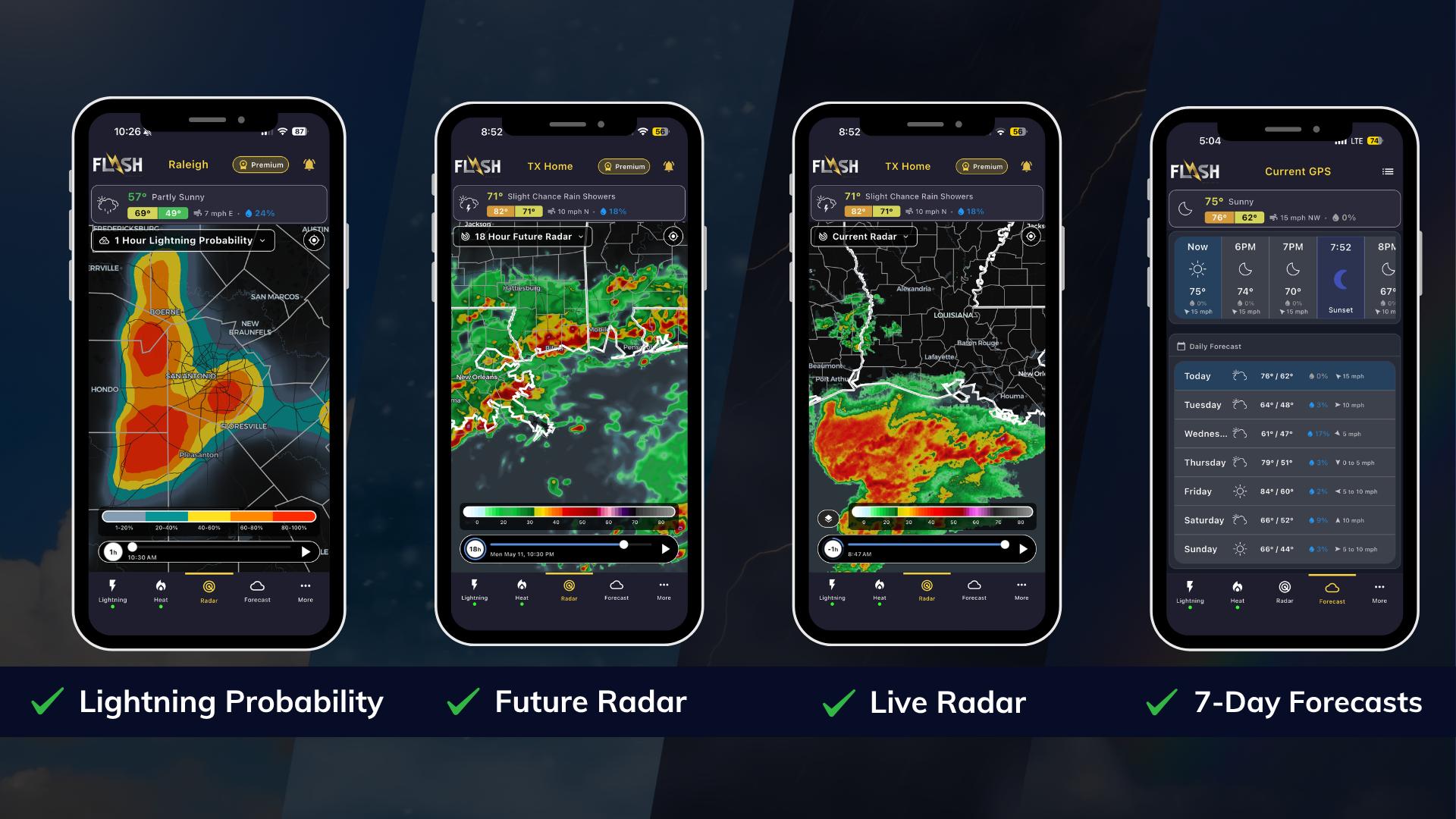
FirstStrike’s strike-level prediction, refreshed every 2 minutes, reaches the foreman by SMS and mobile push and fires the yard horn integration. The crew is off the roof before the first strike, not after it. Accuracy is up to 99.6% on a one-hour prediction window; the accuracy method page has the detail.
Stay ahead of hail with predictive weather intelligence.
In the field
What do the people running the sites say?
The people making the call are outside, with a sky like this over them.
“Flash AI is one of the greatest technologies I’ve seen in a while. It’s more accurate than any other hail map. I stand behind it 100%. This is a game-changer for the industry.”
RoofingWill GambleInfinity Roofing
Who brings Flash into roofing, and why
The titles that make the call, the problem they describe on the first conversation, and where they gather.
Who buys
CEO
President
Director of Operations
Director of Sales
Director of Technology or Innovation
Key Account Manager
National Accounts Manager
The problem on the first call
Hail: finding and booking the damaged addresses first, with hail history to back up the claim.
Lightning and heat for roof crews and jobsite management.
Rain forecasting for scheduling and jobsite management.
Frost prediction for roofs that are not walkable or safe to be on.
Where these buyers gather
International Roofing Expo
Win the Storm
Western Roofing Expo
Midwest Roofing Contractors Association
National Roofing Contractors Association
Questions roofing owners, operations and sales leaders ask about hail alerts
Yes. Predictive Hail predicts a size class for each 1×1 km cell, severe, damaging or destructive, and records the observed class as the storm passes, every five minutes. Alerts and the swath report carry the class, not a vague “hail possible”.
Yes. The swath report exports as PDF and PNG with the cell, the size class and the timestamp for every address in the event. The adjuster gets the same record you do.
Up to 55 minutes before hail reaches a site, refreshed every five minutes with timing down to the minute. Lightning is predicted up to 60 minutes ahead on the same 1×1 km cells, refreshed every 2 minutes, with a 5-hour lightning probability for the day.
No. Flash is software: web app, mobile app, SMS, email and horn integrations. Register the yard, the active jobs and the canvassing territories as sites and the alerts follow them.
Yes. Coverage is the full continental U.S. at 1×1 km resolution, so a storm-restoration territory spanning several counties is a few hundred cells on one map.
Next for a roofing owner
The two products on this page, the competitor comparison, pricing and one customer story.
Book a demo · No sensors required for the forecast
See your own sites on the map before the next storm.
We'll load your locations, replay last season's strikes against Flash's predictions, and show you the alert log your safety officer would have received.