
On this page · 8 sections
What does the FHSAA require?
Florida Statute 1006.165, amended by the Zachary Martin Act in 2020, directs the FHSAA to set heat-stress rules that apply year-round: monitoring heat stress and modifying, suspending or moving activities, hydration, cooling zones with cold-water immersion and a trained person, and onsite cold-water immersion in every emergency action plan. Policy 41 of the FHSAA Handbook is where those rules live.
Each member school monitors heat stress with a WBGT device that has a black globe. Anytime the WBGT reading is reasonably expected to exceed 82 degrees, the device is used to record conditions and modifications are implemented. It is set up at least 15–20 minutes beforehand, three feet above the surface, in the sun, and monitored approximately every 30 minutes.
Reading cadence
Set up at least 15–20 minutes ahead, three feet above the surface, in the sun, not under shade. Monitored approximately every 30 minutes.
The device
A WBGT device with a black globe; a fan is recommended. Indoor mode in gyms that are not climate-controlled.
Cooling zones
Cold-water immersion tubs or equivalent, an adequate supply of ice, and an individual trained to administer cold-water immersion present.
Heat illness education
Coaches and student-athletes complete the NFHS Heat Illness Prevention course every year.
The FHSAA WBGT threshold table
Five bands for practice, read from the on-site WBGT device: one table for the whole state, with no regional categories. The row colour follows the Flash alert scale your athletic trainers already see in the app.
| WBGT | Activity limit | Rest breaks | Equipment |
|---|---|---|---|
| Under 82.0 | Normal activities | None listed | None listed |
| 82.1 – 87.0 | No time limit listed | Three separate 4-minute breaks per hour of activity | None listed |
| 87.1 – 90.0 | Maximum 2 hours of activity time | Four separate 4-minute breaks per hour of activity | Football: helmet, shoulder pads and shorts only |
| 90.1 – 92.0 | Maximum 1 hour of activity time; no conditioning activities | Five separate 4-minute breaks | No protective equipment permitted |
| 92.1 and above | No outdoor activities | — | — |
Source: FHSAA 2026-27 Handbook, Policy 41.8, WBGT Index for Practices (p. 106), checked 5 Oct 2026. Ranges as printed. If the WBGT rises into 87.1–90.0 after practice has begun, football players may continue in football pants without changing into shorts. Contests follow a separate FHSAA table (Policy 41.9.5), with breaks set sport by sport.
Where does Flash fit?
Flash is a forecast for planning, not an on-site meter: FHSAA compliance uses the on-site WBGT reading. Flash's WBGT forecast tells you at 1 pm what the 4 pm reading is likely to be, so you can move practice instead of cancelling it.
Heat: plan, don't cancel
The outlook runs per field for every hour of the afternoon, against the five FHSAA bands. Shift the start, swap the equipment plan or go indoors before the cars arrive.
Lightning: up to 60 minutes ahead
Strike-level prediction on a 1×1 km cell, refreshed every 2 minutes. Up to 99.6% lightning prediction accuracy on a one-hour window, measured against NLDN ground-truth strikes — method published.
Accuracy methodReturn to play: the all-clear timer
After the last strike inside your radius, Flash runs your policy's all-clear timer and logs it, so play resumes on evidence.
Weather Command Center
Flash Heat and WBGT prediction WBGT forecast, heat index, air temperature and dew point per 1×1 km cell
What does a planning day look like?
Illustrative example · Not live weather — the readings are examples, the rules are the FHSAA's
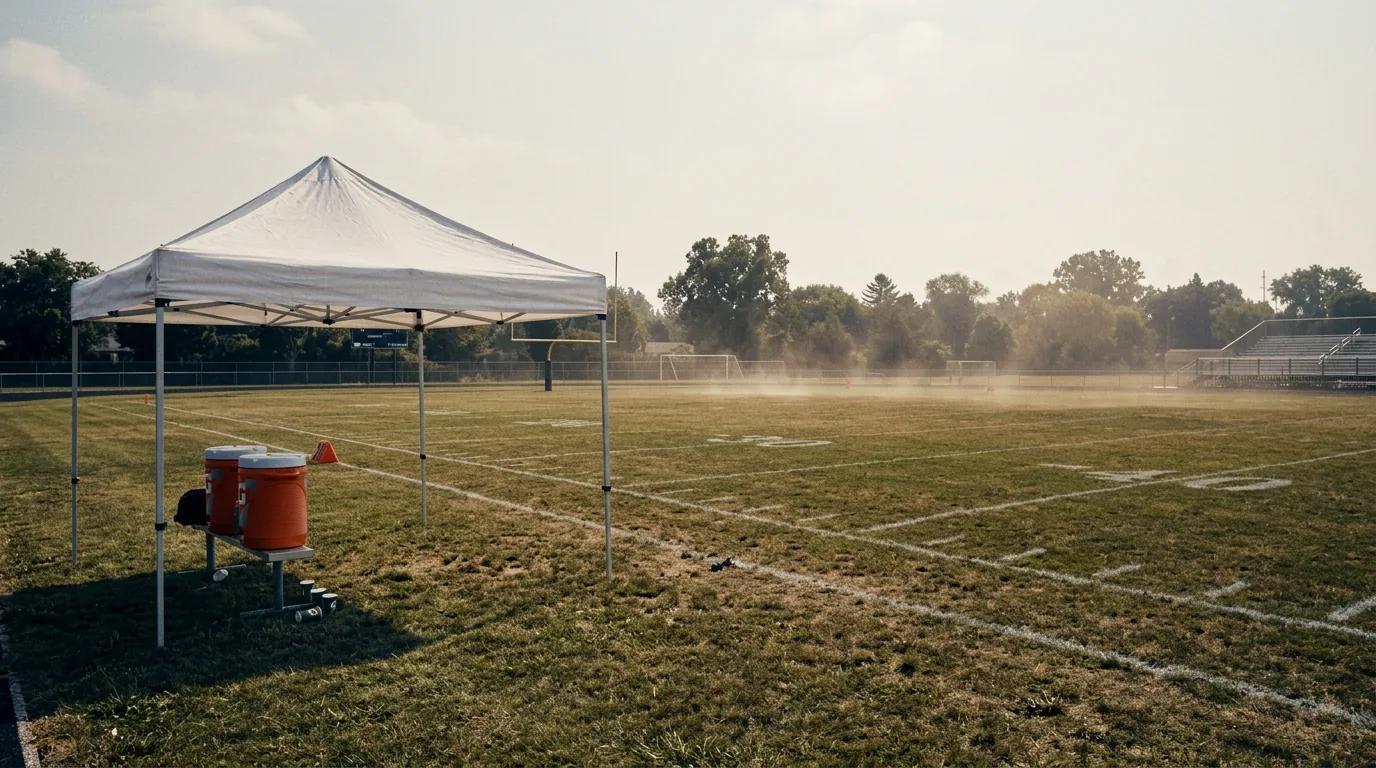
6:30 pm · The reading that decides the day
The band you land in sets the clock, the breaks and the pads.
Flash WBGT forecast for the practice field: 86 by 3 pm, into 87.1–90.0 by 4 pm. The athletic director flags the football session.
Decision: run at 4 pm under the 2-hour cap with four 4-minute breaks an hour, or push to 6:30 pm. The AD pushes. The bus, the trainers and the parents hear now, not at 3:45.
Practice starts on a reading of 84.6, the 82.1–87.0 band, from a device set up in the sun, three feet above the field, 20 minutes earlier. Three 4-minute breaks per hour, the cooling zone ready; the next reading is at 7:00.
Flash lightning alert: a strike is predicted inside the site radius within the next 60 minutes. The field clears.
Last strike inside the radius. Flash starts the all-clear timer.
All clear. Practice resumes; the alert log records who was warned, when, and when play returned.
What should the athletic director keep on file?
Policy 41 has the WBGT device record conditions whenever the reading is expected to exceed 82, and sets sanctions for head coaches who break it. Keep these together so a question from the FHSAA, the district or a parent is answered from one folder.
- WBGT readings with times, about every 30 minutes whenever the reading is expected to exceed 82, and the modification each one triggered.
- Where the device was set up: in the sun, three feet above the surface, at least 15–20 minutes before activity.
- NFHS Heat Illness Prevention course completion for every coach and student-athlete, each year.
- The emergency action plan, with onsite cold-water immersion before a student is transported to a hospital.
- The Flash alert log: lightning alerts, who was notified, the all-clear, and the WBGT forecast the schedule decision was based on.
Which other states publish WBGT policies?
Every state page follows this template: verified thresholds, the reading cadence, what to keep on file, and where the WBGT forecast fits.
State by state
Same instrument, different bands — the WBGT forecast travels with you.
- Georgia (GHSA)
- Texas (UIL)
- Arizona (AIA)
- Arkansas (AAA)
- Colorado (CHSAA)
- Hawaii (HHSAA)
- Illinois (IHSA)
- Kansas (KSHSAA)
- Massachusetts (MIAA)
- Mississippi (MHSAA)
- Missouri (MSHSAA)
- Nevada (NIAA)
- New Hampshire (NHIAA)
- New Mexico (NMAA)
- North Carolina (NCHSAA)
- Ohio (OHSAA)
- West Virginia (WVSSAC)
- Oklahoma (OSSAA)
- Alabama (AHSAA)
- California (CIF)
- Connecticut (CIAC)
- Iowa (IHSAA / IGHSAU)
- Kentucky (KHSAA)
- Louisiana (LHSAA)
- Minnesota (MSHSL)
- Nebraska (NSAA)
- New Jersey (NJSIAA)
- New York (NYSPHSAA)
- South Carolina (SCHSL)
- South Dakota (SDHSAA)
- Utah (UHSAA)
- Vermont (VPA)
- Virginia (VHSL)
- Washington (WIAA)
- Wisconsin (WIAA)
Sources
- FHSAA — 2026-27 Handbook, Policy 41, Exertional Heat Illness, pp. 103–109. Practice and contest WBGT tables, monitoring, cooling zones, acclimatization. Checked 5 Oct 2026.s3.amazonaws.com/fhsaa.org/documents/2026/7/22/2627_handbook_website_7_22.pdf (opens in a new tab)
- Florida Statutes — s. 1006.165, Well-being of students participating in extracurricular activities; training (2026). Checked 5 Oct 2026.leg.state.fl.us/statutes/index.cfm?App_mode=Display_Statute&URL=1000-1099/1006/Sections/1006.165.html (opens in a new tab)
- Laws of Florida — ch. 2020-91, the Zachary Martin Act. Checked 5 Oct 2026.laws.flrules.org/2020/91 (opens in a new tab)
FHSAA documents are published at fhsaa.com (opens in a new tab).
Frequently asked
No. FHSAA compliance is decided by the reading from the WBGT device at the practice site. Flash's WBGT forecast tells you where that reading is heading — a scheduling tool, not a compliance instrument.
Anytime the WBGT reading is reasonably expected to exceed 82 degrees, Policy 41 has the device record conditions and modifications implemented. Set it up at least 15–20 minutes ahead and monitor it approximately every 30 minutes.
No. Contests follow a separate FHSAA table, Policy 41.9.5, with breaks set sport by sport. In football, for example, from 87.1 to 90.0 there is a mandatory 3-minute hydration break at or near the six-minute mark of each quarter.
Yes. The first 14 calendar days are an acclimatization period for all sports. In football, the first two days are helmets only, days 3–5 add shoulder pads with shorts, and full gear begins on day six.