

On this page · 8 sections
What does the AAA require?
The AAA approved the Wet Bulb Globe Thermometer as its heat and humidity measure for practices in 2019, and Sports Medicine Rule 7 of the 2026-2027 handbook lists the WBGT guidelines as required. They follow modified American College of Sports Medicine guidance on when practices can be scheduled, how much of each hour goes to rest and hydration, and the reading at which activity stops. The same guidelines apply at summer events and to marching band programs.
A scientifically approved WBGT instrument should be used at each practice when the temperature is above 80 degrees Fahrenheit. It is set up 30 minutes before practice, read 15 minutes before the start, and read again every 30 minutes during practice. Practice is timed from when players report to the practice or workout area until they leave it, and a weather interruption stops the clock until practice resumes.
Reading cadence
Instrument set up 30 minutes before practice and read 15 minutes before it. Then every 30 minutes during practice.
Cool zone
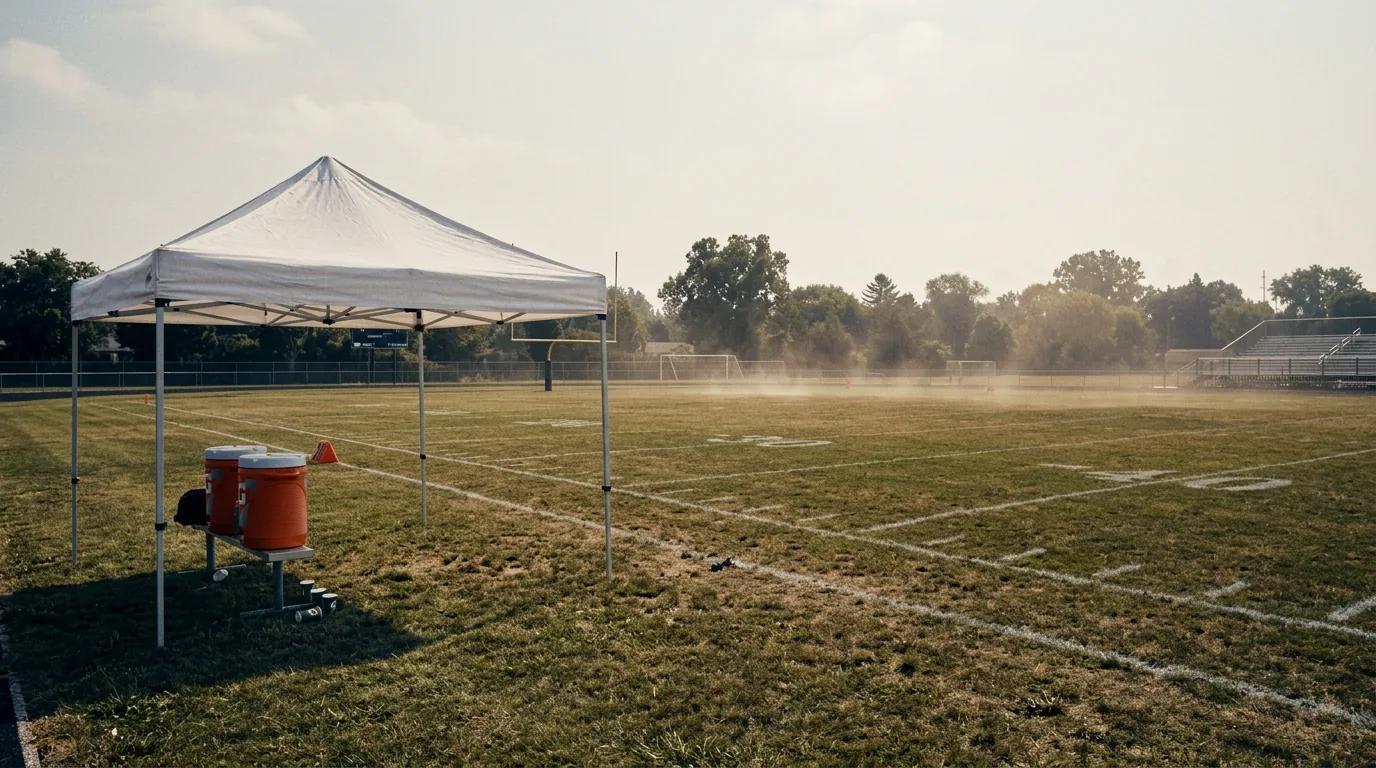
Required at every practice: breaks held out of direct sunlight, with cold tubs, misting fans or other cooling devices.
Rest breaks and water
Rest breaks cannot be combined with any other activity, and players get unlimited access to hydration.
Walk-throughs
Not part of practice time and no longer than one hour: no conditioning, no contact drills, no protective equipment, no full-speed drills.
The AAA WBGT threshold table
Five bands, read from the WBGT instrument, one table for the whole state. The row colour follows the Flash alert scale your athletic trainers already see in the app.
| WBGT | Activity limit | Rest breaks | Football equipment |
|---|---|---|---|
| Under 82.0 | Normal activities | Separate rest breaks each hour of practice; breaks should equal 10 minutes per hour | None listed |
| 82.0 – 86.9 | Use discretion for intense or prolonged exercise; watch at-risk players carefully | At least three separate rest breaks each hour, minimum 4 minutes each | None listed |
| 87.0 – 89.9 | Maximum length of participation 2 hours | All sports: 20 minutes of rest breaks distributed throughout the hour of participation | Helmet, shoulder pads and shorts during practice; protective equipment removed for conditioning activities |
| 90.0 – 92.0 | Maximum length of participation 1 hour | All sports: 30 minutes of rest breaks distributed throughout the hour of participation | No protective equipment may be worn; no conditioning activities |
| Over 92 | No outdoor workouts — delay practice until a cooler WBGT level is reached | — | — |
Source: AAA 2026-2027 Handbook, Sports Medicine Rule 7, Required Guidelines for Use of Wet Bulb Globe Thermometer (pp. 88–89), and the AAA Wet Bulb Guidance sheet (ahsaa.org), checked 15 Oct 2026. Ranges as printed. For regularly scheduled competitions the rule asks schools to use the EAP for high heat and humidity, consider altering the start time and provide extra time outs for rest and hydration.
Where does Flash fit?
Flash is a forecast for planning, not an on-site meter: AAA compliance uses the reading from your WBGT instrument, 15 minutes before and every 30 minutes during practice. Flash's 6-hour WBGT outlook tells you at 1 pm what the 4 pm reading is likely to be, so you can move practice instead of cancelling it.
Heat: plan, don't cancel
The outlook runs per field for every hour of the afternoon, against the five AAA bands. Shift the start, swap the equipment plan or go indoors before the cars arrive.
Lightning: up to 60 minutes ahead
Strike-level prediction on a 1×1 km cell, refreshed every 2 minutes. Up to 99.6% lightning prediction accuracy on a one-hour window, measured against NLDN ground-truth strikes — method published.
Accuracy methodReturn to play: the all-clear timer
After the last strike inside your radius, Flash runs your policy's all-clear timer and logs it. The practice clock stops for the weather stoppage, as Rule 7 sets out.
Weather Command Center
Flash Heat and WBGT prediction 6-hour WBGT outlook, heat index, air temperature and dew point per 1×1 km cell
What does a planning day look like?
Illustrative example · Not live weather — the readings are examples, the rules are the AAA's
6:15 pm · The reading that decides the day
The band you land in sets the clock, the breaks and the pads.
Flash 6-hour WBGT outlook for the practice field: 85 by 3 pm, into 87.0–89.9 by 4 pm. The athletic director flags the football session.
Decision: run at 4 pm under the 2-hour cap with 20 minutes of rest breaks in every hour, or push to 6:30 pm. The AD pushes. The bus, the trainers and the parents hear now, not at 3:45.
Reading 15 minutes before practice, on an instrument set up at 6:00: 84.1, the 82.0–86.9 band. Three 4-minute breaks per hour go on the plan and the cool zone is ready.
Flash lightning alert: a strike is predicted inside the site radius within the next 60 minutes. The field clears and the practice clock stops.
Last strike inside the radius. Flash starts the all-clear timer.
All clear. Practice resumes for its remaining time; the alert log records who was warned, when, and when play returned.
What should the athletic director keep on file?
Rule 7 sets when to read the WBGT but does not prescribe a log. Keeping these together means a question from the AAA, the district or a parent is answered from one folder.
- WBGT readings with times — 15 minutes before practice, then every 30 minutes — and the band each one fell in.
- The decision each band triggered: participation length, rest breaks, football equipment, the cool zone.
- The instrument used and the manufacturer's recalibration schedule.
- Each coach's heat illness training, required every three years, and the football team's annual parent meeting on heat illness.
- The Flash alert log: lightning alerts, who was notified, the all-clear, and the 6-hour outlook the schedule decision was based on.
Which other states publish WBGT policies?
Every state page follows this template: verified thresholds, the reading cadence, what to keep on file, and where the WBGT forecast fits.

State by state
Same instrument, different bands — the WBGT forecast travels with you.
- Georgia (GHSA)
- Texas (UIL)
- Florida (FHSAA)
- Arizona (AIA)
- Colorado (CHSAA)
- Hawaii (HHSAA)
- Illinois (IHSA)
- Kansas (KSHSAA)
- Massachusetts (MIAA)
- Mississippi (MHSAA)
- Missouri (MSHSAA)
- Nevada (NIAA)
- New Hampshire (NHIAA)
- New Mexico (NMAA)
- North Carolina (NCHSAA)
- Ohio (OHSAA)
- West Virginia (WVSSAC)
- Oklahoma (OSSAA)
- Alabama (AHSAA)
- California (CIF)
- Connecticut (CIAC)
- Iowa (IHSAA / IGHSAU)
- Kentucky (KHSAA)
- Louisiana (LHSAA)
- Minnesota (MSHSL)
- Nebraska (NSAA)
- New Jersey (NJSIAA)
- New York (NYSPHSAA)
- South Carolina (SCHSL)
- South Dakota (SDHSAA)
- Utah (UHSAA)
- Vermont (VPA)
- Virginia (VHSL)
- Washington (WIAA)
- Wisconsin (WIAA)
Sources
- AAA — 2026-2027 Handbook, Sports Medicine, Rule 7, Required Guidelines for Use of Wet Bulb Globe Thermometer, pp. 88–89; Rules 4 and 6 on heat illness training and the pre-season meeting. Checked 15 Oct 2026.files-backend.assets.thrillshare.com/documents/asset/uploaded_file/6163/Aaa/4dd843fa-b959-4926-b4b5-a8f263a97331/26.27-Handbook-FINAL-%282%29.pdf (opens in a new tab)
- AAA — Use of Wet Bulb Globe Thermometer (WBGT) for Heat and Humidity Monitoring During Practice (Required), the Wet Bulb Guidance sheet. Checked 15 Oct 2026.drive.google.com/file/d/1xtg0wLDyKXarlJskRcNJ3Vu_uWYPnWPr/view (opens in a new tab)
- AAA — Sports Medicine Info, ahsaa.org. Checked 15 Oct 2026.ahsaa.org/page/sports-medicine-info (opens in a new tab)
AAA documents are published at ahsaa.org (opens in a new tab).
Frequently asked
No. AAA compliance is decided by the reading from a scientifically approved WBGT instrument at practice. Flash's 6-hour outlook tells you where that reading is heading — a scheduling tool, not a compliance instrument.
When the temperature is above 80 degrees Fahrenheit. Set the instrument up 30 minutes before practice, read it 15 minutes before the start, and read it every 30 minutes during practice.
The bands are written for practice. For regularly scheduled competitions, Rule 7 asks schools to use the emergency action plan for high heat and humidity, consider altering the start time, make sure athletes are hydrated and acclimatized, and provide extra time outs for rest and hydration.
Yes. The handbook requires schools to follow the WBGT heat guidelines at all summer events, and marching band programs must also abide by the approved WBGT guidelines.