
On this page · 8 sections
What does the NCHSAA require?
Section 2.3 of the NCHSAA Handbook covers heat illness prevention and management for all sports. Every school should have a heat illness prevention and management policy for all sanctioned activities, and that policy must be followed. A venue-specific emergency action plan, written and practised, must be in place ahead of time, and coaches, athletic training staff and first responders review heat illness signs and the plan before each season.
WBGT should be measured with a scientifically approved device for all sports when student-athletes may be at risk for exertional heat illness, every hour beginning 30 minutes before practice starts. At 90 or above, practice is suspended; contests may continue with mandatory breaks set by the gameday administrator. The NCHSAA reminds schools that the chart must be followed during summer workouts too.
Reading cadence
Every hour, beginning 30 minutes before practice, with a scientifically approved WBGT device.
Chart on site
A WBGT chart should be available at practices and contests, along with supplies to assess WBGT and to cool an athlete rapidly.
Cold-water immersion
From 85, a cold or ice immersion pool on site for practice. Cool first, transport second.
Weigh-ins and water
Pre- and post-practice weigh-ins should be conducted. Unlimited drinking opportunities during hotter practices; never withhold water.
The NCHSAA WBGT threshold table
Five bands, read in degrees Fahrenheit from the on-site WBGT device. The NCHSAA prints each band as one guideline; the activity, break and equipment parts are split into columns here, word for word. The row colour follows the Flash alert scale your athletic trainers already see in the app.
| WBGT Index (°F) | Athletic activity guidelines | Rest/water breaks | Pads and equipment |
|---|---|---|---|
| Less than 80 | Unlimited activity with primary cautions for new or unconditioned athletes or extreme exertion | Schedule mandatory rest/water breaks (5 min water/rest break every 30 min) | None listed |
| 80 – 84.9 | Normal practice for athletes; closely monitor new or unconditioned athletes and all athletes during extreme exertion | Schedule mandatory rest/water breaks (5 min water/rest break every 25 min) | None listed |
| 85 – 87.9 | New or unconditioned athletes should have reduced intensity practice and modifications in clothing. Well-conditioned athletes should have more frequent rest breaks and hydration as well as cautious monitoring for symptoms of heat illness. Have cold or ice immersion pool on site for practice | Schedule frequent mandatory rest/water breaks (5 min water/rest break every 20 min) | None listed |
| 88 – 89.9 | All athletes must be under constant observation and supervision. Have cold or ice immersion pool on site for practice | Schedule frequent mandatory rest/water breaks (5 min water/rest break every 15 min) | Remove pads and equipment |
| 90 or above | Suspend all practices; Competition may continue with mandatory water breaks as designated by gameday administrator | — | — |
Source: NCHSAA 2026-2027 Handbook, Section 2.3.3, WBGT Index and Athletic Activity Chart (p. 48), and the matching chart PDF on nchsaa.org, verified 15 Oct 2026. Ranges as printed. Section 2.3.5(e) repeats the top band: at 90 or above suspend practice; contests may continue but must include mandatory breaks as directed by the gameday administrator.
Where does Flash fit?
Flash is a forecast for planning, not an on-site meter: NCHSAA compliance uses the reading from your scientifically approved WBGT device. Flash's 6-hour WBGT outlook tells you at 1 pm what the 4 pm reading is likely to be, so you can move practice instead of cancelling it.
Heat: plan, don't cancel
The outlook runs per field for every hour of the afternoon, against the five NCHSAA bands. Shift the start, swap the equipment plan or go indoors before the cars arrive.
Lightning: up to 60 minutes ahead
Strike-level prediction on a 1×1 km cell, refreshed every 2 minutes. Up to 99.6% lightning prediction accuracy on a one-hour window, measured against NLDN ground-truth strikes — method published.
Accuracy methodReturn to play: the all-clear timer
After the last strike inside your radius, Flash runs your policy's all-clear timer and logs it, so play resumes on evidence.
Weather Command Center
Flash Heat and WBGT prediction 6-hour WBGT outlook, heat index, air temperature and dew point per 1×1 km cell
What does a planning day look like?
Illustrative example · Not live weather — the readings are examples, the rules are the NCHSAA's
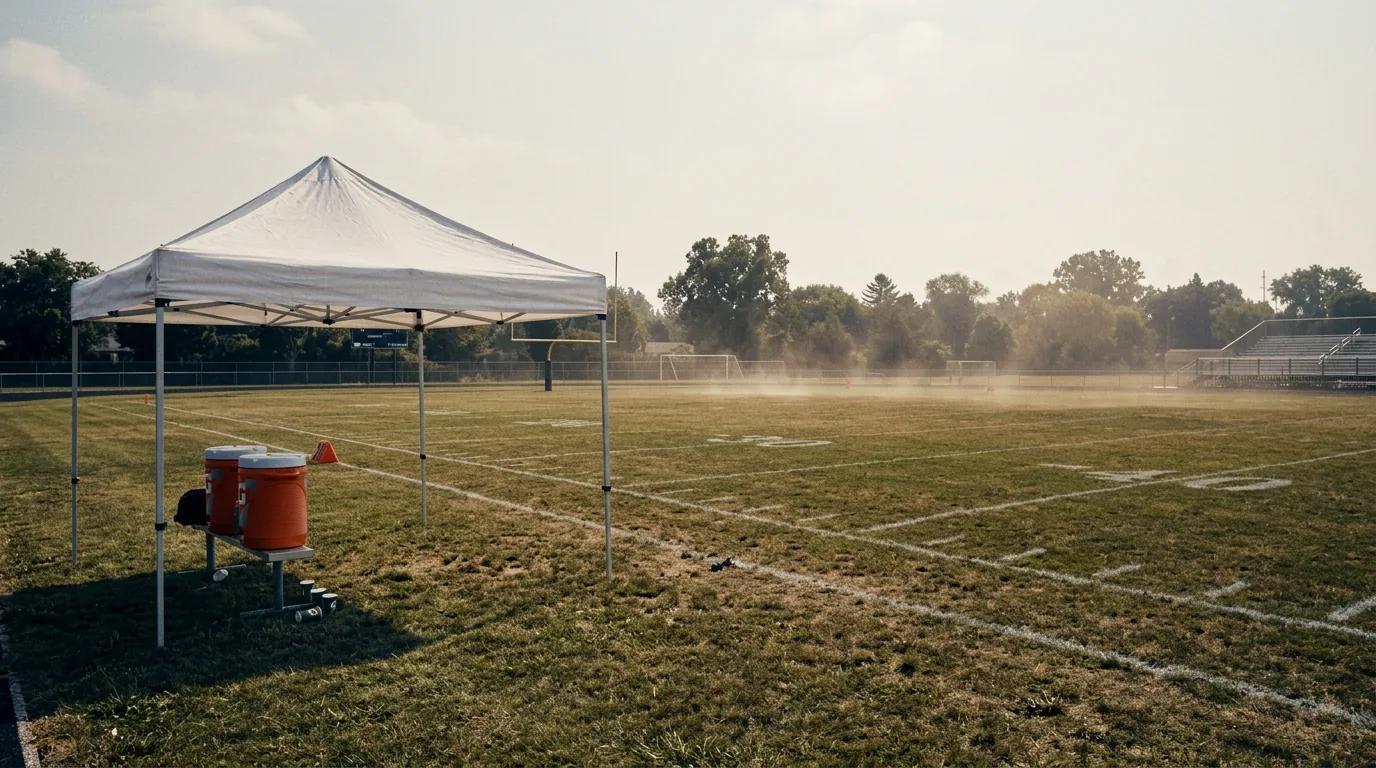
6:00 pm · The reading that decides the day
The band you land in sets the breaks, the pads and the cold tub.
Flash 6-hour WBGT outlook for the practice field: 87 by 3 pm, into 88–89.9 by 4 pm. The athletic director flags the football session.
Decision: run at 4 pm with pads and equipment off, a 5-minute water/rest break every 15 minutes and a cold tub on site, or push to 6:30 pm. The AD pushes. The bus, the trainers and the parents hear now, not at 3:45.
First on-site WBGT reading, 30 minutes before practice: 84.2, the 80–84.9 band. A 5-minute water/rest break every 25 minutes goes on the plan; the next reading is due at 7:00.
Flash lightning alert: a strike is predicted inside the site radius within the next 60 minutes. The field clears.
Last strike inside the radius. Flash starts the all-clear timer.
All clear. Practice resumes; the alert log records who was warned, when, and when play returned.
What should the athletic director keep on file?
Section 2.3 asks every school to have a heat illness policy and to follow it. Keeping these together means a question from the NCHSAA, the district or a parent is answered from one folder.
- WBGT readings with times — the first 30 minutes before practice, then every hour — and the device used.
- The band each reading fell in and the decision it triggered: break schedule, pads and equipment, the immersion pool.
- The school's heat illness prevention and management policy, and the venue-specific emergency action plan.
- Pre- and post-practice weigh-ins, and any athlete held out for not being within 3% of the previous pre-practice weight.
- The Flash alert log: lightning alerts, who was notified, the all-clear, and the 6-hour outlook the schedule decision was based on.
Which other states publish WBGT policies?
Every state page follows this template: verified thresholds, the reading cadence, what to keep on file, and where the WBGT forecast fits.
State by state
Same instrument, different bands — the WBGT forecast travels with you.
- Georgia (GHSA)
- Texas (UIL)
- Florida (FHSAA)
- Arizona (AIA)
- Arkansas (AAA)
- Colorado (CHSAA)
- Hawaii (HHSAA)
- Illinois (IHSA)
- Kansas (KSHSAA)
- Massachusetts (MIAA)
- Mississippi (MHSAA)
- Missouri (MSHSAA)
- Nevada (NIAA)
- New Hampshire (NHIAA)
- New Mexico (NMAA)
- Ohio (OHSAA)
- West Virginia (WVSSAC)
- Oklahoma (OSSAA)
- Alabama (AHSAA)
- California (CIF)
- Connecticut (CIAC)
- Iowa (IHSAA / IGHSAU)
- Kentucky (KHSAA)
- Louisiana (LHSAA)
- Minnesota (MSHSL)
- Nebraska (NSAA)
- New Jersey (NJSIAA)
- New York (NYSPHSAA)
- South Carolina (SCHSL)
- South Dakota (SDHSAA)
- Utah (UHSAA)
- Vermont (VPA)
- Virginia (VHSL)
- Washington (WIAA)
- Wisconsin (WIAA)
Sources
- NCHSAA — 2026-2027 Handbook, Section 2.3, Heat Illness Prevention and Management, with the WBGT Index and Athletic Activity Chart (pp. 48–50). Thresholds, reading cadence, acclimatization, cooling. Verified 15 Oct 2026.nchsaa.org/wp-content/uploads/2026/10/26-27-Handbook-Update-10626.pdf (opens in a new tab)
- NCHSAA — Wet Bulb Globe Temperature (WBGT) Index and Athletic Activity Chart, standalone PDF. Verified 15 Oct 2026.nchsaa.org/wp-content/uploads/2026/07/WBGTChart.pdf (opens in a new tab)
- NCHSAA — Heat Illness Prevention for Summer Workouts. The chart must be followed during summer workouts. Verified 15 Oct 2026.nchsaa.org/news-2023-7-10-heat-illness-prevention-summer-workouts/ (opens in a new tab)
NCHSAA documents are published at nchsaa.org (opens in a new tab).
Frequently asked
No. The NCHSAA has WBGT measured with a scientifically approved device at the practice site. Flash's 6-hour outlook tells you where that reading is heading — a scheduling tool, not a compliance instrument.
Section 2.3.5 says WBGT should be assessed every hour, beginning 30 minutes before the start of practice, for all sports when athletes may be at risk for exertional heat illness.
At 90 or above, practices are suspended but competition may continue with mandatory water breaks as designated by the gameday administrator.
Yes. The NCHSAA reminds schools that the WBGT Index and Athletic Activity Chart must be followed, even during summer workouts.