
In this article · 6 sections
Every lightning policy has two decisions in it. The first is when to clear the field. The second is when to let people back out. The all-clear rule governs the second one, and it is the rule most often argued with on a sideline.
The arguments are understandable. Thirty minutes is a long time with a bus waiting, officials on the clock and a crowd in the stands. But the rule is short, it is the same in every major guideline, and once you see why it is built the way it is, it stops looking arbitrary. This article walks through what the guidance actually says, why the clock is tied to the last strike, and which of the two decisions a 60-minute lightning forecast changes — and which one it leaves alone.
What the guidance actually says
Three documents sit behind most school, college and recreation lightning policies in the United States, and on the all-clear they agree.
- National Weather Service
- For organized outdoor activities, the NWS asks organizers to keep a written lightning safety plan and follow it without exception, and to wait at least 30 minutes after the last thunder before going back outside. It also recommends that the person watching the weather is not the coach, umpire or referee.
- NFHS
- The National Federation of State High School Associations publishes a default policy (most recently revised October 2024). Play is suspended for at least 30 minutes once thunder is heard or lightning is seen; the 30 minutes run from the last thunder or lightning; and any thunder or lightning during the count resets it. Where a lightning detection network is available, play is suspended for lightning inside a 10-mile radius and resumes only 30 minutes after the last strike inside that radius.
- NATA
- The National Athletic Trainers' Association position statement on lightning safety (Journal of Athletic Training, March 2013) also suspends activity until 30 minutes after the last strike or sound of thunder, and asks for a designated weather watcher and a chain of command naming who removes people from the field.
Notice what none of them say. None of them shortens the wait because the sky has brightened, the rain has stopped or the radar looks clear. The NWS gives the reason directly: a thunderstorm can still produce lightning after it appears to have moved on, and its lightning threat reaches roughly 6 to 10 miles out from the base of the cloud.
Why the clock starts at the last strike, not the last rumble
Read literally, the NWS and NFHS rules start the count at the last thunder heard. That works when a trained person is standing outside listening. It works less well in practice: thunder is hard to hear over a crowd, a PA system or traffic, two people on the same sideline will disagree about whether that was thunder, and nobody writes down the minute it happened.
A detection record removes the guesswork. NFHS already allows for it: with a nationally connected detection network, the count runs from the last strike recorded inside your radius. That strike has a timestamp and a location. The clock has a defined start, every reset has a defined cause, and when someone asks afterwards why play resumed at 8:22 rather than 8:10, the answer is in the log rather than in somebody’s memory.
Two caveats, both from the NFHS guidelines themselves. First, if you hear thunder or see lightning on site, that takes precedence over any app or detection device — the clock resets regardless of what the screen says. Second, the reverse case: at night, flashes from a distant storm can be visible with no thunder at all. NFHS notes that such a storm may not be a threat, and that independently verified detection data helps settle the question. A strike record showing nothing inside the radius is exactly that data.
- 10 miNFHS radius when detection data is available
- 30 minfrom the last strike or thunder
- Reseton every new strike inside the radius
What Flash runs on the all-clear
Flash does not invent its own rule here. Each site carries your policy's radius and all-clear wait. Detected strikes sit on the same map as the forecast, the return-to-play timer starts from the last strike inside your radius, and it resets on its own if another one lands. You decide whether the all-clear goes out automatically or has to be acknowledged by a named person, and which channels each role receives: app, SMS, email or the horn and strobe on the field.
Every step is written to a timestamped log: the prediction, who was told and when, who acknowledged it, the last strike, and when the all-clear went out. That record is what the guidelines’ "follow the plan without exception" looks like when someone later asks you to prove it.
After the last strike
A bright sky is not an all-clear. Thirty minutes without a strike inside the radius is.
What a 60-minute forecast changes — and what it does not
Prediction does not shorten the all-clear. The 30-minute count is a return-to-play rule built on strikes that have happened, and it should stay that way. What a forecast changes is the first decision, and the quality of the second.
| Attribute | Detection and the 30-minute rule | Forecast plus the 30-minute rule |
|---|---|---|
| First call | Made when thunder is heard or the first strike lands inside the radius | Made when a cell is forecast to reach the site inside the hour, before the first strike |
| Clearing the field | All at once, often in rain, with the storm already in range | Staged: Advisory, then Watch to stage staff, then Warning to clear |
| The all-clear | 30 minutes from the last strike or thunder; resets on each new one | The same 30 minutes, run from the strike record and logged |
| Resume or call it | A guess about whether another storm is behind this one | The next hour’s forecast for the site’s cell shows whether another cell is on its way |
Detection and the 30-minute rule
- First call
- Made when thunder is heard or the first strike lands inside the radius
- Clearing the field
- All at once, often in rain, with the storm already in range
- The all-clear
- 30 minutes from the last strike or thunder; resets on each new one
- Resume or call it
- A guess about whether another storm is behind this one
Forecast plus the 30-minute rule
- First call
- Made when a cell is forecast to reach the site inside the hour, before the first strike
- Clearing the field
- Staged: Advisory, then Watch to stage staff, then Warning to clear
- The all-clear
- The same 30 minutes, run from the strike record and logged
- Resume or call it
- The next hour’s forecast for the site’s cell shows whether another cell is on its way
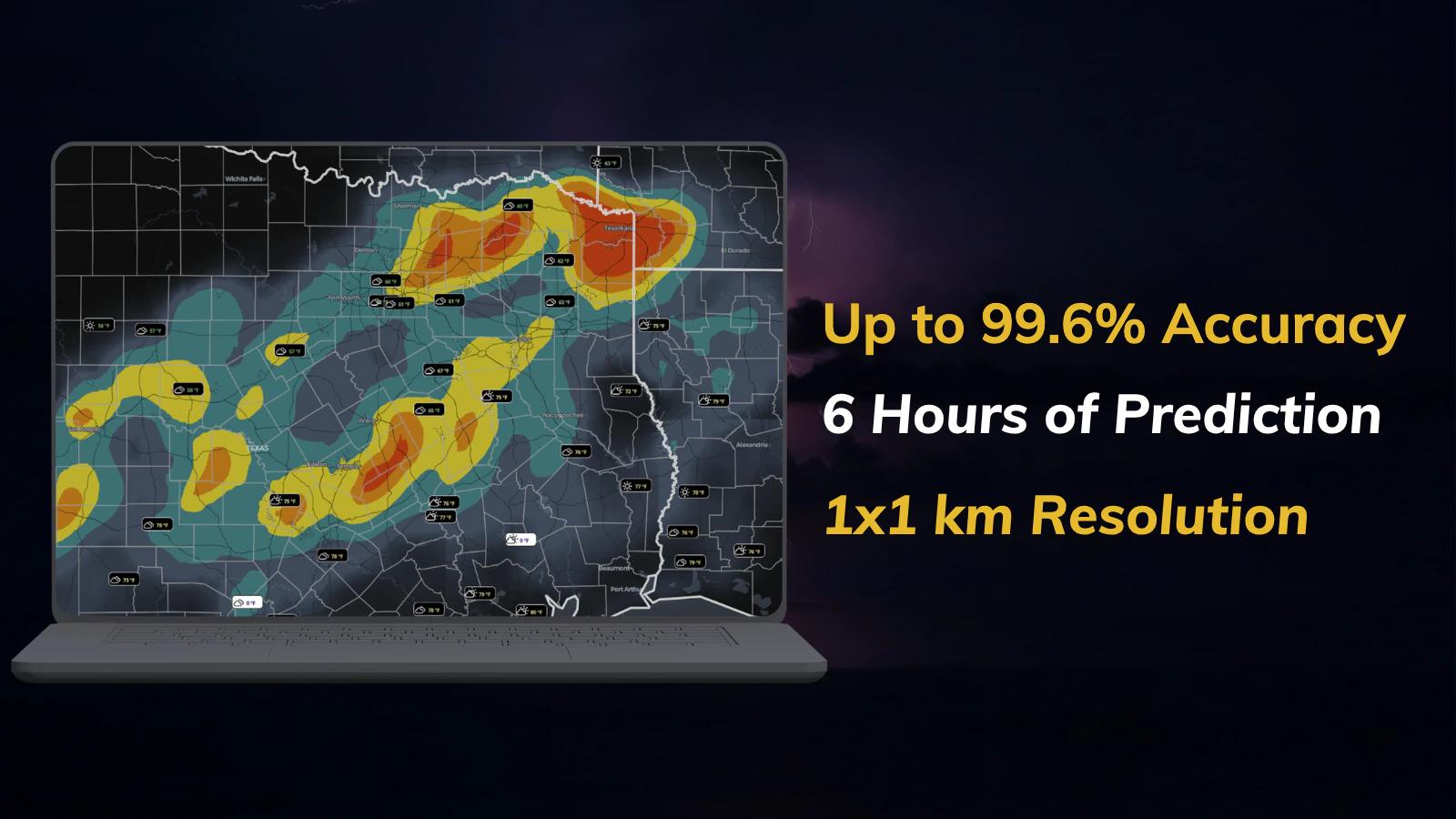
The first row is the one that saves people. Flash forecasts, for every 1×1 km cell across the continental U.S., the likelihood of a cloud-to-ground strike in the next 60 minutes, refreshed every 2 minutes. Its one-hour prediction accuracy is up to 99.6%, scored against NLDN ground-truth strikes; the accuracy method shows how. An athletic trainer who sees an Advisory at the hour mark has time to confirm the shelter route, get buses and gates staffed, and clear the field on a Warning while the walk is still dry.
The last row matters more than it looks. When the 30 minutes run out, the question in the press box is rarely "is it safe now?" — the rule answers that — but "is it worth restarting?" If the forecast shows another cell reaching the site inside the hour, you can call the night and send the buses rather than warm up, restart and clear the field a second time.
Writing it into your policy
- Name the person who makes the call and the person who watches the weather, and say that neither is the coach or the official running the game.
- State the radius, and that the 30-minute count runs from the last strike inside it, resets on every new one, and resets on thunder heard or lightning seen on site.
- State the forecast level that starts the clearing — Advisory or Warning, whichever your policy sets — so the first call is no longer a judgment made in the rain.
- Say how the all-clear is issued: automatically, or acknowledged by a named person, and on which channels.
- Keep the log with the season’s records, and review the policy with coaches and officials before the season starts, as NFHS recommends.
Frequently asked
At least 30 minutes after the last thunder heard or lightning seen, under NWS, NFHS and NATA guidance. Where detection data is used, NFHS counts the 30 minutes from the last strike inside a 10-mile radius.
Yes. NFHS says any thunder or lightning after the count begins resets the clock and a new 30-minute count starts. Flash resets the return-to-play timer automatically when another strike lands inside your radius.
No. The all-clear is a return-to-play rule built on strikes that have happened. A forecast moves the first decision earlier and tells you whether another cell is coming; the 30-minute count stays.
Thunder wins. NFHS is explicit that what you see and hear on site takes precedence over a mobile app or detection device. Restart the count.
Founder & Chief Meteorologist, Flash Weather
Founder of Flash Weather, a 20-year National Weather Service veteran and former Chief Meteorologist at Atlanta Hartsfield-Jackson International Airport.