

In this article · 5 sections
Flash forecasts lightning on a grid of 1×1 km cells across the continental U.S. For a single practice field, that is simple: the field sits in one cell and gets one answer. For a golf course, a university campus or a construction yard, the site is bigger than the unit, and a few decisions follow from that.
How big is a 1×1 km cell?
One kilometre is about 0.62 miles, so a cell is a square a little over half a mile on each side: roughly 247 acres, or about 0.39 square miles. That is small next to the areas lightning policies are usually written around. A 10-mile radius — the distance the NFHS uses when detection data is available — covers about 314 square miles, which is in the region of 800 cells.
- 0.62 mieach side of a cell
- ≈247 acresarea of one cell
- ≈800cells inside a 10-mile radius
The point of the small unit is that the forecast describes your ground, not your county. The point of knowing its size is that a long golf routing, a campus with fields on two sides of a road, or a yard with a laydown area across the street can easily cross a cell boundary. As a rule of thumb, a large golf property or a mid-sized farm is usually a handful of cells.
How alerts are scored across cells
Every lightning forecast Flash issues is scored per cell, and only against its own cell. A cloud-to-ground strike recorded by NLDN is compared with the flags issued for the cell it landed in, during the hour before it. If that cell was flagged, it is a hit; if not, a miss. A flagged cell-window with no strike in it is a false alarm. Nothing is pooled across a site and nothing is counted twice.
| Cell on the site | Flag | Strike in that cell | Scored as |
|---|---|---|---|
| North field | Advisory at 2:10 pm | 2:47 pm | Hit |
| Car park | Advisory at 2:12 pm | None by 3:12 pm | False alarm |
| East range | No flag | 2:30 pm | Miss |
Flag
- North field
- Advisory at 2:10 pm
- Car park
- Advisory at 2:12 pm
- East range
- No flag
Strike in that cell
- North field
- 2:47 pm
- Car park
- None by 3:12 pm
- East range
- 2:30 pm
Scored as
- North field
- Hit
- Car park
- False alarm
- East range
- Miss
That is the worked example from the accuracy method, and it is the whole arithmetic: accuracy is hits divided by hits plus misses, and the false-alarm ratio is false alarms divided by flagged cell-windows. The one-hour prediction accuracy published there is up to 99.6%. For a multi-cell site, the practical consequence is that a strike on the east range is judged against the east range’s forecast, not the clubhouse’s.
Which cell wakes the horn?
The forecast is per cell. The policy is per site. The horn sits between the two, and that is where the decisions are.
A site's horn and strobe fire on a Warning: a strike predicted inside your policy's radius and window. You choose the level that fires the hardware; most sites sound the horn on Warning and keep Advisory and Watch for people, by app and SMS, so the siren means one thing. Each site carries its own thresholds — alert radius, lead time, and who is told — so a superintendent, an athletic trainer and a safety manager can receive different alerts for the same cell.
For a large site, three set-ups cover most cases:
- One site, one horn
- A golf course or a single yard where everyone comes in together. Register the cells the property covers and let a Warning for the site clear all of it. Simple, and the right answer wherever the walk to shelter is long.
- One site, several alert lists
- A campus with fields spread out. Each field is its own 1×1 km cell with its own alert list: the athletic director sees every field in the Weather Command Center, and a coach only gets the field they are standing on.
- Many sites, one view
- A portfolio such as a management company’s courses. Every property sits in its own cell, and a forecast for one property does not clear or close another, so calls are made course by course instead of as blanket closures.
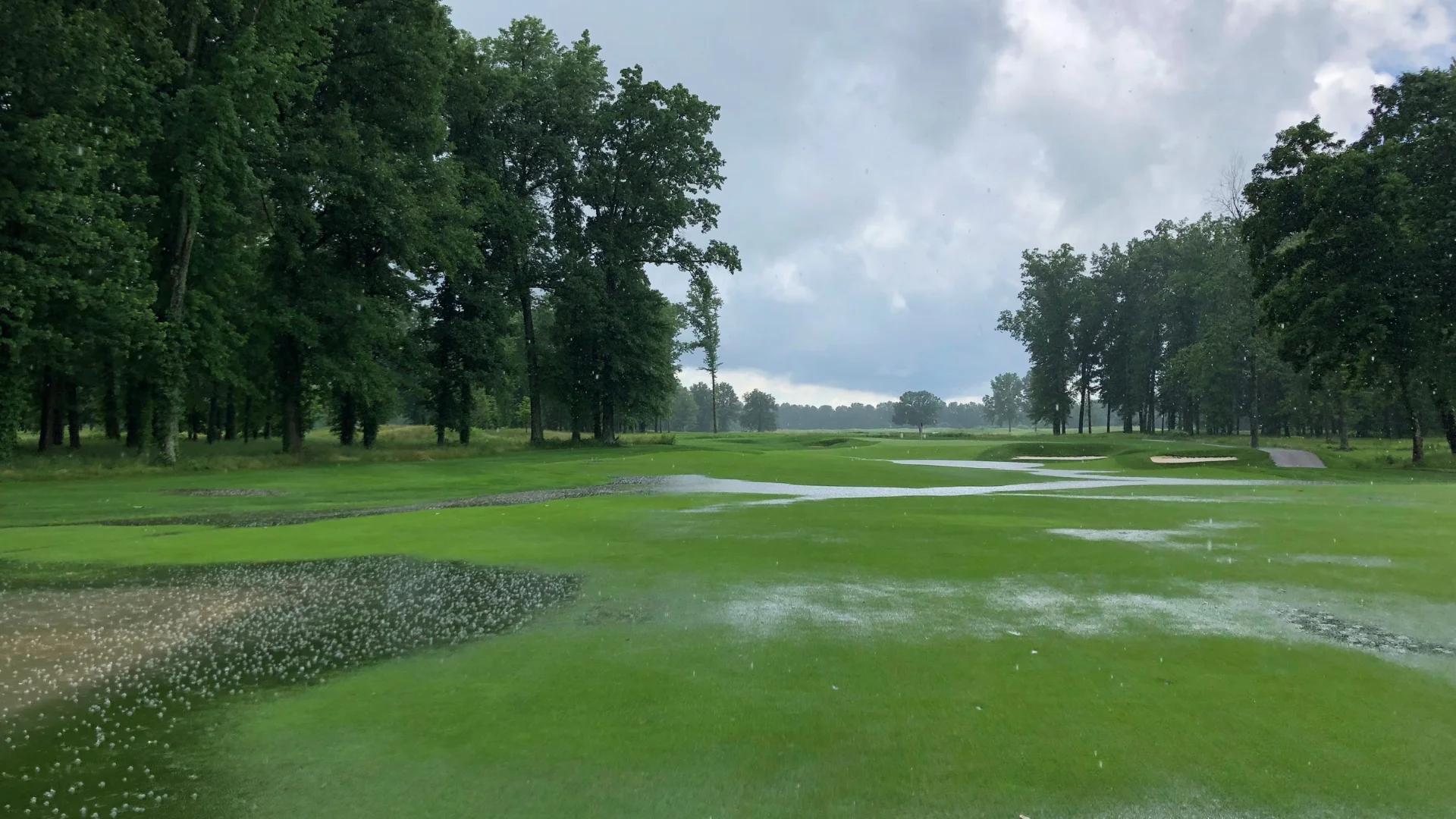
Several cells, one call
Register the cells where people actually are — then decide which alert clears them.
Setting up a large site
- Map where people are, not where the property line is. The back nine, the practice range, the maintenance shed and the parking lot are the places a crew or a crowd has to leave.
- Register the cells those places fall in. The number of cells you register sets the pricing tier, so there is no reason to register empty land.
- Decide which cells share an alert and which have their own. If one horn covers everything, the whole site clears together. If fields are far apart, give each its own list.
- Write the radius and the alert level that clears people into your policy, so the setting in the software and the rule on paper say the same thing.
- Check the log after the first storm: which cell was flagged first, who was told, and how long the walk in took. Adjust the lead time if the walk took longer than you planned.
Frequently asked
About 0.62 miles on each side: roughly 247 acres or 0.39 square miles. A large golf property or a mid-sized farm is usually a handful of cells.
The horn fires on the level you choose — usually Warning, a strike predicted inside your policy's radius and window. You decide whether the whole site shares one alert or each field has its own alert list.
Cell by cell. Each NLDN strike is compared only with the flags for the cell it landed in, during the hour before it, and classed as a hit or a miss; flagged cell-windows with no strike are false alarms.
Pricing is per site, with the number of 1×1 km cells you register setting the tier. The pricing page lists the tiers.