
In this article · 6 sections
A lightning policy only works if the person on the sideline follows it every time, including the evening it costs a playoff game its rhythm. Rules that stop play too often get second-guessed. Rules that stop it too late get people hurt. The choice of trigger — how far out you draw the circle, and whether you react to strikes or to a forecast — decides which way a policy fails.
What the guidance already sets
Start from the floor, because your policy cannot go below it. The NFHS default policy, most recently revised in October 2024, suspends play when thunder is heard or lightning is seen. Where a nationally connected detection network is available, it suspends play for lightning inside a 10-mile radius and resumes only after 30 minutes without a strike inside that radius. The National Weather Service describes the lightning threat as reaching roughly 6 to 10 miles out from the base of a storm. Your state association may adopt or adapt the NFHS policy; check its current version before writing your own.
Two other parts of that guidance matter as much as the distance. NFHS asks for one named staff member who monitors the weather and makes the suspension and resumption calls, and says that anyone following the guidelines shall not be challenged. The NWS adds that the person monitoring should not be the coach, umpire or referee. A rule your trainers will follow is, first, a rule that gives them the authority to follow it.
A wide radius: early, and often
A detection radius reacts to strikes that have already happened. Drawing it wider buys time: a strike 10 miles out is a storm that has not reached you yet. The cost is area. A 10-mile circle covers about 314 square miles; a 6-mile circle covers about 113. The wider circle is nearly three times the ground in which any strike stops your game and restarts your 30-minute count — including strikes from a storm that slides past and never comes closer.
Those stoppages are not errors; the rule did what it says. But they are the stoppages coaches remember, and a trainer who has cleared a field three times for storms that never arrived is under real pressure to wait a little on the fourth.
A tight radius: fewer stops, less time
Shrink the circle and the needless stoppages fall away, but so does the lead time. The first strike inside a tight radius is closer, so the storm is closer. Take an illustrative storm moving at 20 mph: it covers 4 miles in 12 minutes. Every mile you take off the radius removes about three minutes between the trigger and the storm’s arrival — minutes that were meant for the walk to the gym.
And for a storm that builds overhead rather than approaching from a distance, no radius gives you any warning at all. The first strike is the first signal, and it is already inside every circle you could draw.
A forecast for your cell: the trigger moves before the strike
The third option changes what the trigger is. Instead of waiting for a strike inside a circle, the policy reacts to a forecast that a strike is coming. Flash forecasts, for each 1×1 km cell, the likelihood of a cloud-to-ground strike in the next 60 minutes, refreshed every 2 minutes, with one-hour prediction accuracy of up to 99.6% against NLDN strikes. Each site carries its own thresholds: the alert radius, the lead time, and who is told at which level.
That splits the decision into stages. An Advisory says a cell is forecast to reach the site inside the hour; the trainer sees it, and nothing changes on the field. A Watch stages staff: shelter routes confirmed, buses and gates staffed. A Warning clears the field, sounds the horn and strobe, and is logged with the time. The overhead-storm case, the one no radius can catch, is the case a forecast is built for.
| Attribute | Wide radius (detection) | Tight radius (detection) | Cell forecast (Flash) |
|---|---|---|---|
| Trigger | First strike inside a large circle | First strike inside a small circle | A strike predicted inside your radius and window |
| Lead time | Good for approaching storms; none for one building overhead | Short for approaching storms; none for one building overhead | Up to 60 minutes per 1×1 km cell, including storms that build overhead |
| Stoppages for storms that miss | Frequent: any strike in a large area stops play | Fewer, because the area is smaller | Tracked as the false-alarm ratio beside the hit rate, per cell; the method is published |
| What the trainer sees | A strike count and a distance | A strike count and a distance | Advisory, Watch, Warning for the site |
Wide radius (detection)
- Trigger
- First strike inside a large circle
- Lead time
- Good for approaching storms; none for one building overhead
- Stoppages for storms that miss
- Frequent: any strike in a large area stops play
- What the trainer sees
- A strike count and a distance
Tight radius (detection)
- Trigger
- First strike inside a small circle
- Lead time
- Short for approaching storms; none for one building overhead
- Stoppages for storms that miss
- Fewer, because the area is smaller
- What the trainer sees
- A strike count and a distance
Cell forecast (Flash)
- Trigger
- A strike predicted inside your radius and window
- Lead time
- Up to 60 minutes per 1×1 km cell, including storms that build overhead
- Stoppages for storms that miss
- Tracked as the false-alarm ratio beside the hit rate, per cell; the method is published
- What the trainer sees
- Advisory, Watch, Warning for the site
A forecast does not replace the detection rule; it sits in front of it. Keep the radius your association requires for suspension and for the 30-minute count. Use the forecast so that by the time that rule fires, the field is already empty.
Writing a rule trainers will actually follow
- One trigger per action. Say which level stages staff and which level clears the field. "Clear on Warning" is a rule; "use your judgment when the Advisory comes in" is not.
- One person with the authority. Name the staff member who makes the call, and write in the NFHS line that a person following the policy is not to be challenged.
- The association floor stays. Thunder heard or lightning seen on site, or a strike inside the required radius, suspends play whatever the forecast says, and resets the 30-minute count.
- The same settings on paper and in the software. The radius, the lead time and the alert level that clears people should match your written policy exactly.
- A record of every call. The Weather Command Center logs the prediction, who was told, who acknowledged it and when the all-clear went out. A trainer whose decisions are on record is easier to back.
- An annual review. NFHS asks for the policy to be reviewed with administrators, coaches and officials every year, and shared with athletes and parents at the start of the season.
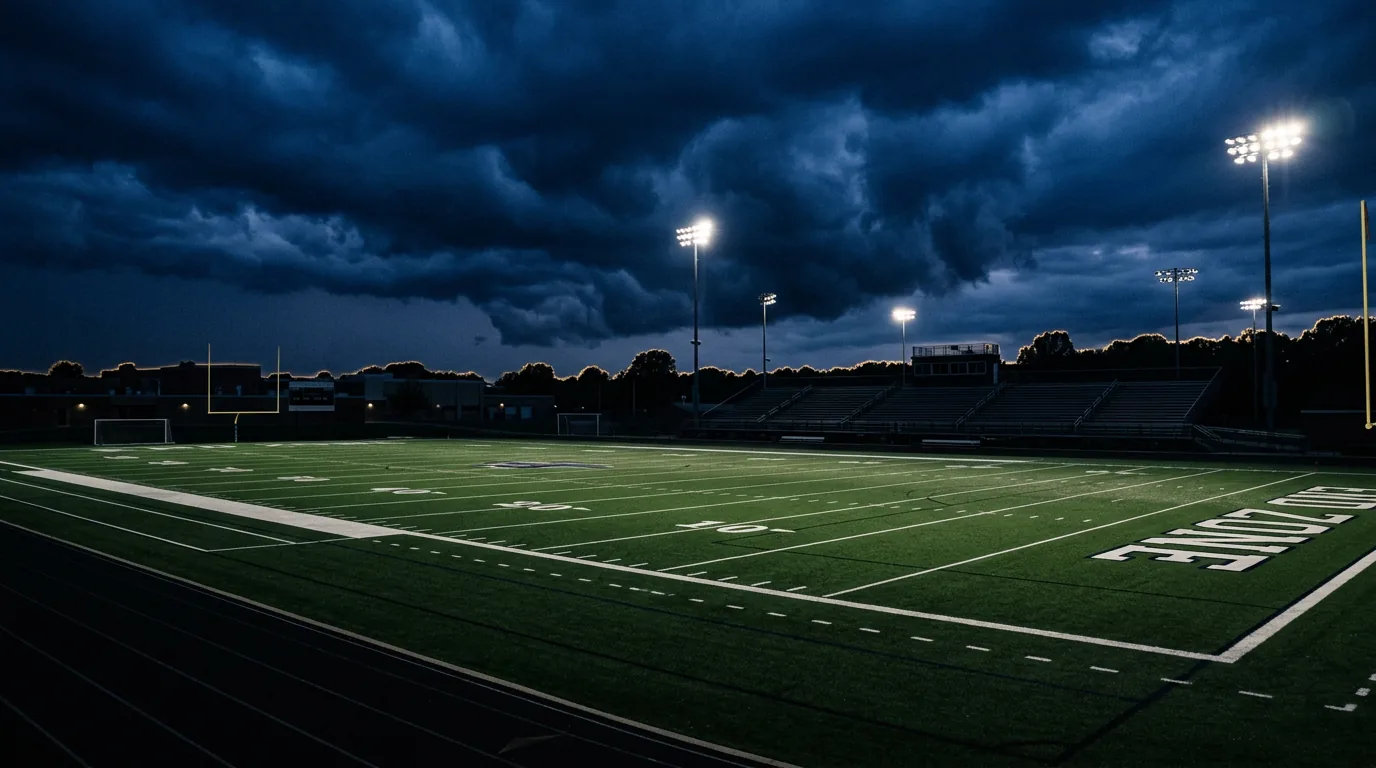
Watch · staff staged
The field clears on Warning. Everything else is ready before that.
Frequently asked
The NFHS default policy uses 10 miles where detection data is available, and the NWS describes the threat as reaching about 6 to 10 miles from a storm. Follow your state association’s current policy as the minimum.
Because it covers so much ground. A 10-mile circle is about 314 square miles, nearly three times a 6-mile circle, so strikes from storms that pass by still stop play and restart the count.
No. Keep the radius your association requires for suspension and the 30-minute count. The forecast sits in front of it, so the field is clear before that rule fires.
A named staff member, under NFHS guidance, who is not to be challenged when following the policy. The NWS recommends that the person monitoring the weather is not the coach, umpire or referee.
Founder & Chief Meteorologist, Flash Weather
Founder of Flash Weather, a 20-year National Weather Service veteran and former Chief Meteorologist at Atlanta Hartsfield-Jackson International Airport.