
On this page · 8 sections
What does SDHSAA require?
The heat section of the SDHSAA handbook is mostly a list of recommended precautions, with a few firm requirements. Every fall-sport coach, paid or volunteer, completes the NFHS Heat Illness Prevention course each year before coaching, and every coach completes the NFHS course “The Collapsed Student” once every two years.
The handbook recommends testing the air with a WBGT index before practice or a game, and lists the precautions for each band below. Since 2025, every school must have an emergency action plan that addresses whole-body cooling and the use of wet bulb globe thermometers in decisions about practice and competition.
Reading before activity
Test the air with a WBGT index before practice or a game. A heat index calculator is offered as an alternative method.
Emergency action plan
Required since 2025: it must address whole-body cooling and using WBGT thermometers for practice and competition decisions.
Coach education
Fall coaches complete the NFHS Heat Illness Prevention course every year; all coaches take “The Collapsed Student” every two years.
Water
Water available in unlimited quantities, and someone checking that athletes actually drink it.
The SDHSAA WBGT threshold table
Five bands, read from the WBGT index, as the SDHSAA handbook prints them. The row colour follows the Flash alert scale your athletic trainers already see in the app.
| WBGT (°F) | Activity limit | Rest breaks | Football equipment |
|---|---|---|---|
| Below 82 | Normal activity | At least 3 breaks of at least 3 minutes each per workout | None listed |
| 82 – 86.9 | Use discretion for intense or prolonged exercise. Watch at-risk players | At least 3 breaks of at least 4 minutes each per workout | None listed |
| 87 – 89.9 | Maximum practice time 2 hours | At least 4 breaks of at least 4 minutes each | Football should use helmet, shoulder pads, and shorts, all protective equipment removed for conditioning |
| 90 – 92.0 | Maximum practice time 1 hour | 20 minutes of rest breaks | No protective equipment |
| 92.1 and above | No outdoor workouts | — | — |
Source: SDHSAA Athletics Handbook, Physical Exams and Health Issues (Revised 6/26), Heat Stress and Athletic Participation, item 6 (sdhsaa.com), checked 15 Oct 2026. Ranges as printed; the handbook cites NATA, 2023.
Where does Flash fit?
Flash is a forecast for planning, not an on-site meter: SDHSAA guidance runs on the WBGT reading taken before practice. Flash's 6-hour WBGT outlook tells you at 1 pm what the 4 pm reading is likely to be, so you can move practice instead of cancelling it.
Heat: plan, don't cancel
The outlook runs per field for every hour of the afternoon, against the five SDHSAA bands. Shift the start, swap the equipment plan or go indoors before the cars arrive.
Lightning: up to 60 minutes ahead
Strike-level prediction on a 1×1 km cell, refreshed every 2 minutes. Up to 99.6% lightning prediction accuracy on a one-hour window, measured against NLDN ground-truth strikes — method published.
Accuracy methodReturn to play: the all-clear timer
After the last strike inside your radius, Flash runs your policy's all-clear timer and logs it, so play resumes on evidence.
Weather Command Center
Flash Heat and WBGT prediction 6-hour WBGT outlook, heat index, air temperature and dew point per 1×1 km cell
What does a planning day look like?
Illustrative example · Not live weather — the readings are examples, the rules are SDHSAA's
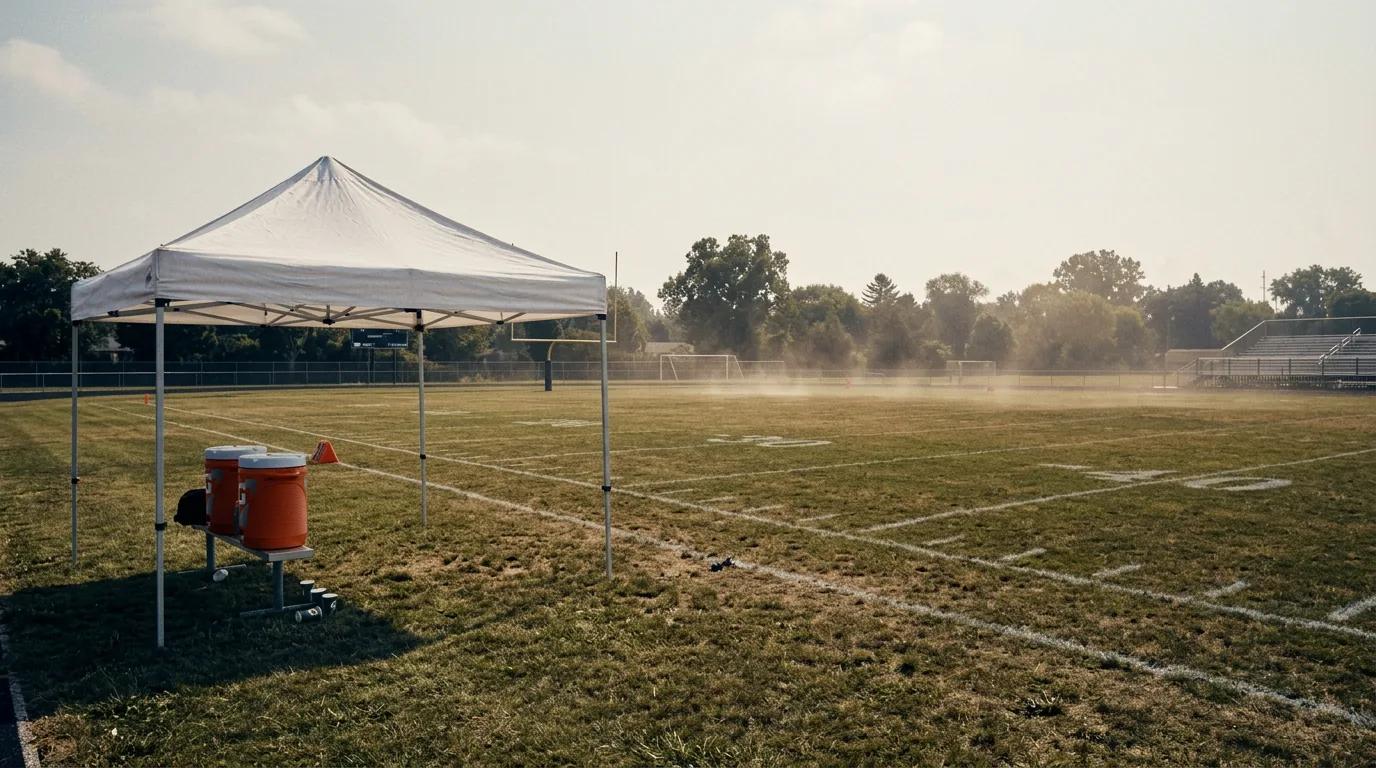
6:15 pm · The reading that decides the day
The band you land in sets the clock, the breaks and the pads.
Flash 6-hour WBGT outlook for the practice field: 85 by 3 pm, into 87–89.9 by 4 pm. The athletic director flags the football session.
Decision: run at 4 pm under the 2-hour cap with four 4-minute breaks, or push to 6:30 pm. The AD pushes. The bus, the trainers and the parents hear now, not at 3:45.
WBGT reading before practice: 84.1, the 82–86.9 band. At least three 4-minute breaks go on the plan and the cooling setup from the emergency action plan is ready.
Flash lightning alert: a strike is predicted inside the site radius within the next 60 minutes. The field clears.
Last strike inside the radius. Flash starts the all-clear timer.
All clear. Practice resumes; the alert log records who was warned, when, and when play returned.
What should the athletic director keep on file?
SDHSAA does not set a records rule for readings, but it does require coach education and an emergency action plan. Keeping these together means a question from SDHSAA, the district or a parent is answered from one folder.
- WBGT readings with times, taken before practice or a game, and the decision each one triggered.
- Each fall coach's NFHS Heat Illness Prevention certificate for the year, and “The Collapsed Student” certificates.
- The emergency action plan, covering whole-body cooling and WBGT-based practice decisions, with copies for all staff.
- Prearranged procedures for medical care, including ambulance service.
- The Flash alert log: lightning alerts, who was notified, the all-clear, and the 6-hour outlook the schedule decision was based on.
Which other states publish WBGT policies?
Every state page follows this template: verified thresholds, the reading cadence, what to keep on file, and where the WBGT forecast fits.

State by state
Same instrument, different bands — the WBGT forecast travels with you.
- Georgia (GHSA)
- Texas (UIL)
- Florida (FHSAA)
- Arizona (AIA)
- Arkansas (AAA)
- Colorado (CHSAA)
- Hawaii (HHSAA)
- Illinois (IHSA)
- Kansas (KSHSAA)
- Massachusetts (MIAA)
- Mississippi (MHSAA)
- Missouri (MSHSAA)
- Nevada (NIAA)
- New Hampshire (NHIAA)
- New Mexico (NMAA)
- North Carolina (NCHSAA)
- Ohio (OHSAA)
- West Virginia (WVSSAC)
- Oklahoma (OSSAA)
- Alabama (AHSAA)
- California (CIF)
- Connecticut (CIAC)
- Iowa (IHSAA / IGHSAU)
- Kentucky (KHSAA)
- Louisiana (LHSAA)
- Minnesota (MSHSL)
- Nebraska (NSAA)
- New Jersey (NJSIAA)
- New York (NYSPHSAA)
- South Carolina (SCHSL)
- Utah (UHSAA)
- Vermont (VPA)
- Virginia (VHSL)
- Washington (WIAA)
- Wisconsin (WIAA)
Sources
- SDHSAA — Athletics Handbook, Physical Exams and Health Issues (Revised 6/26), Heat Stress and Athletic Participation. WBGT bands, coach education, emergency action plans. Checked 15 Oct 2026.sdhsaa.com/Handbook/ATH-PhysicalExamsHealthIssues.pdf (opens in a new tab)
- SDHSAA — Wet Bulb Globe Thermometer Guidelines, linked from the Health & Safety page (regional Cat 1/2/3 chart, US Soccer and Korey Stringer Institute). Checked 15 Oct 2026.sdhsaa.com/HealthSafety/WetBulbGuidelines.pdf (opens in a new tab)
SDHSAA documents are published at sdhsaa.com (opens in a new tab).
Frequently asked
No. SDHSAA guidance runs on a WBGT reading taken at the site before practice or a game. Flash's 6-hour outlook tells you where that reading is heading — a scheduling tool, not a compliance instrument.
Since 2025, every school must have an emergency action plan that addresses whole-body cooling and the use of wet bulb globe thermometers in decisions about practice and competition.
Yes. Every fall-sport coach completes the NFHS Heat Illness Prevention course each year before coaching, and all coaches complete “The Collapsed Student” once every two years.