In this article · 9 sections
If you are pricing lightning safety for a school district, a park system, a golf club or a stadium, most of the systems on your shortlist work the same way: a lightning network locates a strike, and if it lands inside the radius or zone you set, the system alerts your staff. Some add sirens and an on-site weather station; some wrap the alert in a wider weather dashboard. Flash is built around a different question: not "did lightning just strike inside my radius?" but "is lightning likely in this square kilometre in the next hour?" We reviewed the published pages of five detection-based vendors in October 2026. This article compares the approach rather than any one company, so you can decide which fits your policy, or whether you want both.
The short answer
Detection-based systems alert on confirmed strikes. A lightning detection network locates a discharge, and if it falls inside the radius or zone you configured, the system sends a text, email, app notification or siren, usually within seconds. A countdown then restarts with each new strike until the all-clear. Flash forecasts, for every 1×1 km cell, the likelihood of a cloud-to-ground strike in the next 60 minutes, refreshed every 2 minutes, with no hardware required. Choose a detection system if your priority is a strike-confirmed alert, often bundled with sirens and an on-site heat sensor from one supplier. Choose Flash if you need to make the call before the first strike. Many sites run detection and prediction together.
The three kinds of detection system you will be quoted
The trigger is the same in all three: a strike located inside a distance you chose. What differs is what comes with it.
- Software radius alerts. A strike inside a ring, or inside a zone you draw around a campus, sends a text, email, voice call or map pop-up. Distances are set to match your policy, commonly 5 to 15 miles. There is nothing to install, and some are running within a day.
- Detection with on-site sirens and stations. The same trigger sounds horns, strobes and PA messages on poles around the site. These are often sold as packages with a weather station that reads WBGT, heat index, wind and rain, with solar, cellular and battery-backup options.
- Weather dashboards with storm tracking. Strike alerts inside your ranges sit beside storm-path maps that estimate when an existing storm will reach your venue over roughly the next 30 minutes, alerts on dozens of other weather variables, and meteorologists on call.
What detection systems do well
Across the vendors we reviewed, as published in October 2026:
- Strike-confirmed alerts. The trigger is a located strike, in many cases from the NLDN, the same network Flash uses as ground truth when it scores its own forecasts.
- Policies that are easy to enforce. Radii, zones and schedules per location, a countdown that restarts with each strike, and an all-clear signal distinct from the warning.
- Total lightning. Some networks detect in-cloud as well as cloud-to-ground lightning, which can flag an active storm before its first ground strike in range.
- Clear signals on site. Loud horns, strobes, text-to-speech PA messages and countdown displays, with voice options for sites near homes.
- On-site heat readings. Weather stations that read WBGT on your own grounds, which some state heat policies require.
- Records and people. Timestamped delay histories and scheduled reports for claims and compliance, and meteorologist support, in some cases around the clock.
If your heat policy requires a WBGT reading taken on your own site, an on-site station from a detection vendor is a direct way to meet it.
How Flash approaches the same problem
A detection alert starts when a strike lands inside your radius, so the first strike near your field is what sets it off. A storm-path projection helps when a storm tracks in from a distance, but not when a cell builds over your site. Flash works on the hour before. The model ingests 30+ integrated data signals, including radar, satellite and surface observations, and scores every 1×1 km cell across the continental U.S. for the next 60 minutes, re-running every 2 minutes. When your cell is flagged, the athletic trainer, the superintendent or the pool manager gets the call with a time attached, before the first strike.
- 60 minlead time, up to
- 1×1 kmcell per site
- 2 minmodel refresh
- Up to 99.6%one-hour lightning accuracy
Because a forecast can be wrong, Flash scores it like one: hit or miss per cell on the one-hour window, against an independent record of NLDN strikes. The definitions, including first-strike detection and false-alarm ratio, are on the accuracy method page. Several of the detection systems we reviewed publish no accuracy figure or scoring method for their alerts. Whichever vendor you choose, ask for the window, the ground truth, the period and the misses.
Detected strikes still appear on the same Flash map, and the all-clear timer runs from the last strike, so prediction moves the first decision earlier without changing your return-to-play rule. Flash also forecasts hail up to 55 minutes before it reaches a site, and gives a 6-hour WBGT outlook so you can move practice before the reading climbs. It plans around an on-site reading; it does not replace one.
Flash needs no hardware. Alerts go out through the web app, the mobile app, SMS and email, and through relays to horns and strobes you already own. If you want a siren that sounds on the forecast rather than on the strike, Flash Weather Shield is solar-powered and cellular, in Shield, Mini and Micro sizes for courses, fields and pool decks.
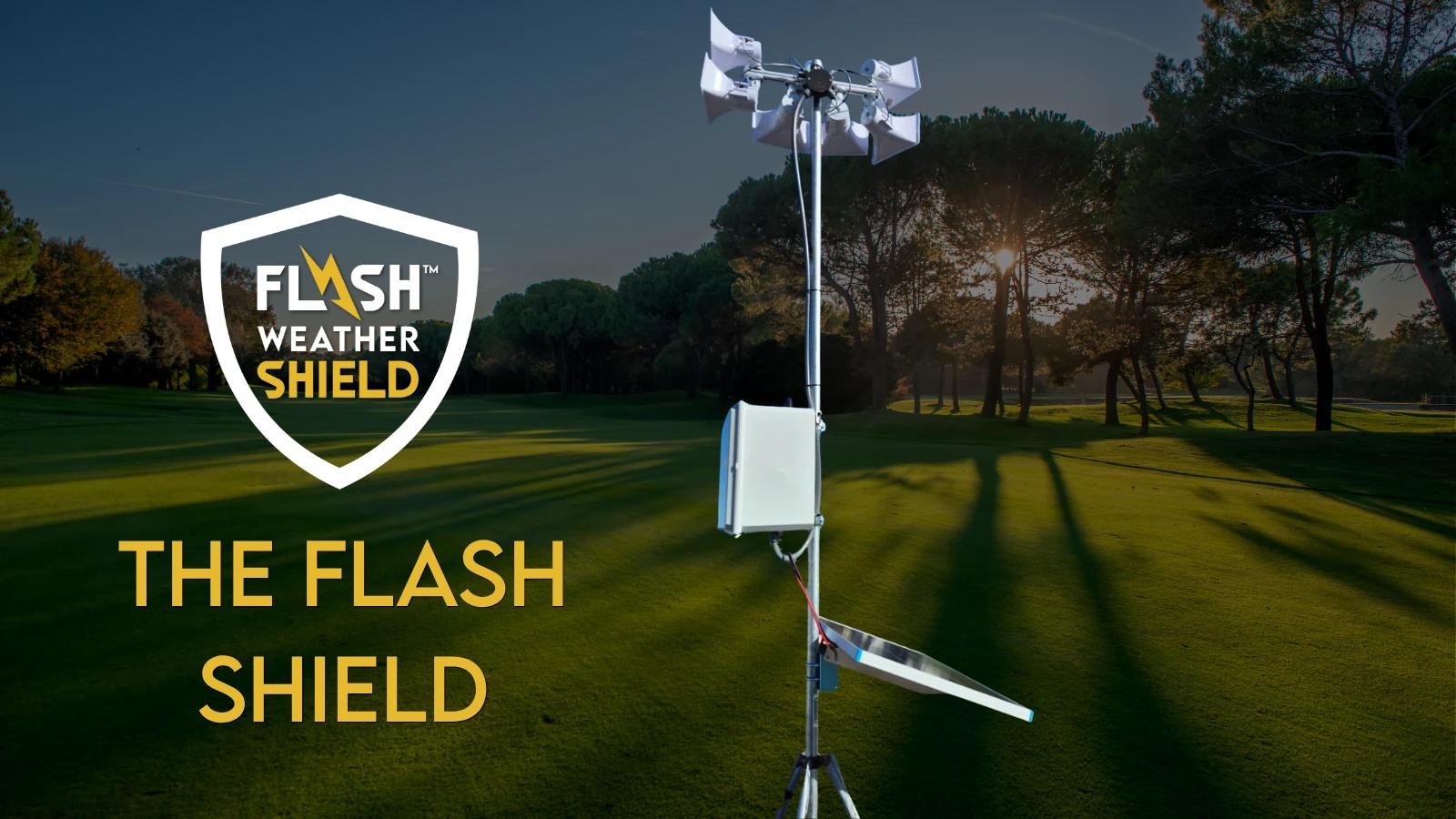
Flash Weather Shield
A siren that sounds on the forecast, for sites that want one.
Detection systems vs Flash, side by side
| Attribute | Detection-based systems | Flash |
|---|---|---|
| What triggers a lightning alert | A strike located by a detection network inside the radius or zone you set | A forecast for your 1×1 km cell, up to 60 minutes before the first strike |
| Stated speed or lead time | Seconds after detection; some dashboards project a storm’s path about 30 minutes ahead | Up to 60 minutes of lead time, refreshed every 2 minutes |
| Coverage | A ring of set miles, or a zone you draw, around each location | Every 1×1 km cell in the continental U.S. |
| All-clear | Countdown restarts with each strike, then an all-clear signal | All-clear timer after the last strike, with detected strikes on the same map |
| Accuracy | Not published by several of the vendors we reviewed; ask for it | Up to 99.6% one-hour accuracy against NLDN strikes; method published |
| Heat | On-site WBGT stations or WBGT forecasts, depending on the vendor | 6-hour WBGT outlook; keep an on-site device where policy names one |
| Hardware | None for software-only alerts; sirens, strobes and stations sold as packages by others | None required; relays for existing horns, or Flash Weather Shield |
| Pricing | Quoted by tier or package; none of the vendors we reviewed publishes prices | Per site, annual, quoted after a demo; free app tier for individuals |
Detection-based systems
- What triggers a lightning alert
- A strike located by a detection network inside the radius or zone you set
- Stated speed or lead time
- Seconds after detection; some dashboards project a storm’s path about 30 minutes ahead
- Coverage
- A ring of set miles, or a zone you draw, around each location
- All-clear
- Countdown restarts with each strike, then an all-clear signal
- Accuracy
- Not published by several of the vendors we reviewed; ask for it
- Heat
- On-site WBGT stations or WBGT forecasts, depending on the vendor
- Hardware
- None for software-only alerts; sirens, strobes and stations sold as packages by others
- Pricing
- Quoted by tier or package; none of the vendors we reviewed publishes prices
Flash
- What triggers a lightning alert
- A forecast for your 1×1 km cell, up to 60 minutes before the first strike
- Stated speed or lead time
- Up to 60 minutes of lead time, refreshed every 2 minutes
- Coverage
- Every 1×1 km cell in the continental U.S.
- All-clear
- All-clear timer after the last strike, with detected strikes on the same map
- Accuracy
- Up to 99.6% one-hour accuracy against NLDN strikes; method published
- Heat
- 6-hour WBGT outlook; keep an on-site device where policy names one
- Hardware
- None required; relays for existing horns, or Flash Weather Shield
- Pricing
- Per site, annual, quoted after a demo; free app tier for individuals
When a detection system is the better fit
- Your written policy is built purely on a detected-strike radius and you mainly need it automated, logged and broadcast across the site.
- Your heat policy requires an on-site WBGT reading and you want that sensor, the siren and the software from one supplier.
- You run large events and want one dashboard for many weather variables, with a meteorologist on call around the clock.
- You want a loud, self-contained horn with battery backup at a site where power is unreliable.
When Flash is the better fit
- Storms build over your site rather than arriving from a distance, so the first strike nearby is often the first warning a detection radius can give.
- You run many sites, such as a district, a park system or a golf portfolio, and want each one on its own 1×1 km cell without installing anything.
- You want the decision to come with a time attached, so you can move warm-ups, hold buses or clear the back nine before a strike rather than after it.
- You want a published, checkable accuracy method behind the alert you act on.
Flash is a Preferred Vendor Partner across all 700+ Troon golf properties, the official weather safety provider of the Big 12 Conference, and the Official Weather Monitoring & Alert System of the NAIA through October 2028.
Running both
This does not have to be either-or. A detection system confirms the strike and anchors the return-to-play clock; Flash gives you the hour before it. If your site already has detection sirens or a WBGT station, keep them, and add Flash as the early call on the phones of the people who make it. The prediction vs sensors vs detection explainer covers how the technologies fit together in one safety plan, and Flash vs on-site lightning sensors covers the other way to warn before a strike.
Frequently asked
Most detection-based systems alert when a strike is located inside your radius or zone, so the first strike in range is what sets them off. Some add storm-path projections or longer-range radar forecasts for planning. Flash forecasts the likelihood of a cloud-to-ground strike per 1×1 km cell for the next 60 minutes.
Many detection systems alert from the NLDN or another national detection network. Flash scores its forecasts against NLDN strikes and shows detected strikes on its map, so both refer to a record of what actually struck.
None of the detection vendors we reviewed in October 2026 publishes a price; most quote software tiers and hardware packages separately. Flash quotes per site, annually, after a demo, and the Flash mobile app has a free tier for individuals.
Yes. Keep the detection alerts and the on-site WBGT reading your policy relies on, and add Flash for the hour before the first strike. Flash alerts reach staff by app, SMS and email, and can drive horns and strobes through relays; whether an existing siren accepts a relay input depends on the unit, so check with its supplier.