In this article · 8 sections
Golf courses, school stadiums and pools across the country have a Sferic Siren on a pole: a horn and strobe that sound when lightning is detected nearby. The system is sold by AEM and runs on the Earth Networks Total Lightning Network. Flash works on a different clock, forecasting the hour before the first strike. This comparison sets out what each publishes, as of 15 October 2026.
The short answer
AEM’s lightning alert system sounds sirens and strobes when the Earth Networks Total Lightning Network detects lightning inside the radius you set, then gives a distinct all-clear. It detects in-cloud as well as cloud-to-ground lightning. Flash forecasts, for every 1×1 km cell, the likelihood of a cloud-to-ground strike in the next 60 minutes, refreshed every 2 minutes, and needs no hardware. If you want a rugged on-site horn tied to a detection network, the Sferic Siren is built for that. If you need the call before the storm is overhead, that is what Flash is for. The two work well together.
What the Sferic Siren and AEM do well
Everything in this section is as published on aem.eco, checked 15 Oct 2026.
- Total lightning. The system detects both in-cloud and cloud-to-ground lightning, which AEM says identifies dangerous storms earlier and more accurately than cloud-to-ground alone.
- Clear signals on site. Sirens and strobes signal when to take shelter, the all-clear uses a different tone from the warning, and an all-clear countdown display shows when it is safe to go back out.
- Control. Alert radius and operating schedules are configurable by site, authorised users can trigger or silence alerts manually, and the system can be tested and managed remotely from any web-enabled device.
- Options for quieter sites. A voice-message option replaces the horn near homes or at smaller complexes, and there is a wall-mounted model.
- Robust hardware. AEM lists a 117 dB omnidirectional horn, battery backup of up to five days without AC power, and a solar power option.
- More than the horn. Alerts can also go out by text, email and mobile app, and AEM’s monitoring software shows lightning with radar and lets you review past lightning and weather data after an event.
AEM lists airports, golf courses, sports complexes, schools and universities, construction sites and mines among the places the system is used, and features Savannah Yacht Club as a customer story.
How Flash approaches the same problem
A detection siren reacts to lightning that has already been located inside your radius. Total lightning detection can pick up in-cloud activity before a cloud-to-ground strike, but the trigger is still a discharge that has happened somewhere in range. Flash starts earlier in the life of the storm: it ingests 30+ integrated data signals and forecasts the likelihood of a cloud-to-ground strike in each 1×1 km cell for the next 60 minutes, re-running every 2 minutes.
- 60 minlead time, up to
- 1×1 kmcell per site
- 2 minmodel refresh
- Up to 99.6%one-hour lightning accuracy
Flash scores that forecast hit or miss per cell against NLDN strikes, and publishes how on the accuracy method page. Detected strikes show on the same Flash map and the all-clear timer runs from the last strike, so your return-to-play rule stays the same.
Flash needs no installation. It alerts through the web app, mobile app, SMS and email, and can drive horns and strobes you already own through relays. Where you want a new on-site siren that sounds on the forecast, Flash Weather Shield is solar-powered and cellular, in Shield, Mini and Micro sizes for courses, fields and pool decks.
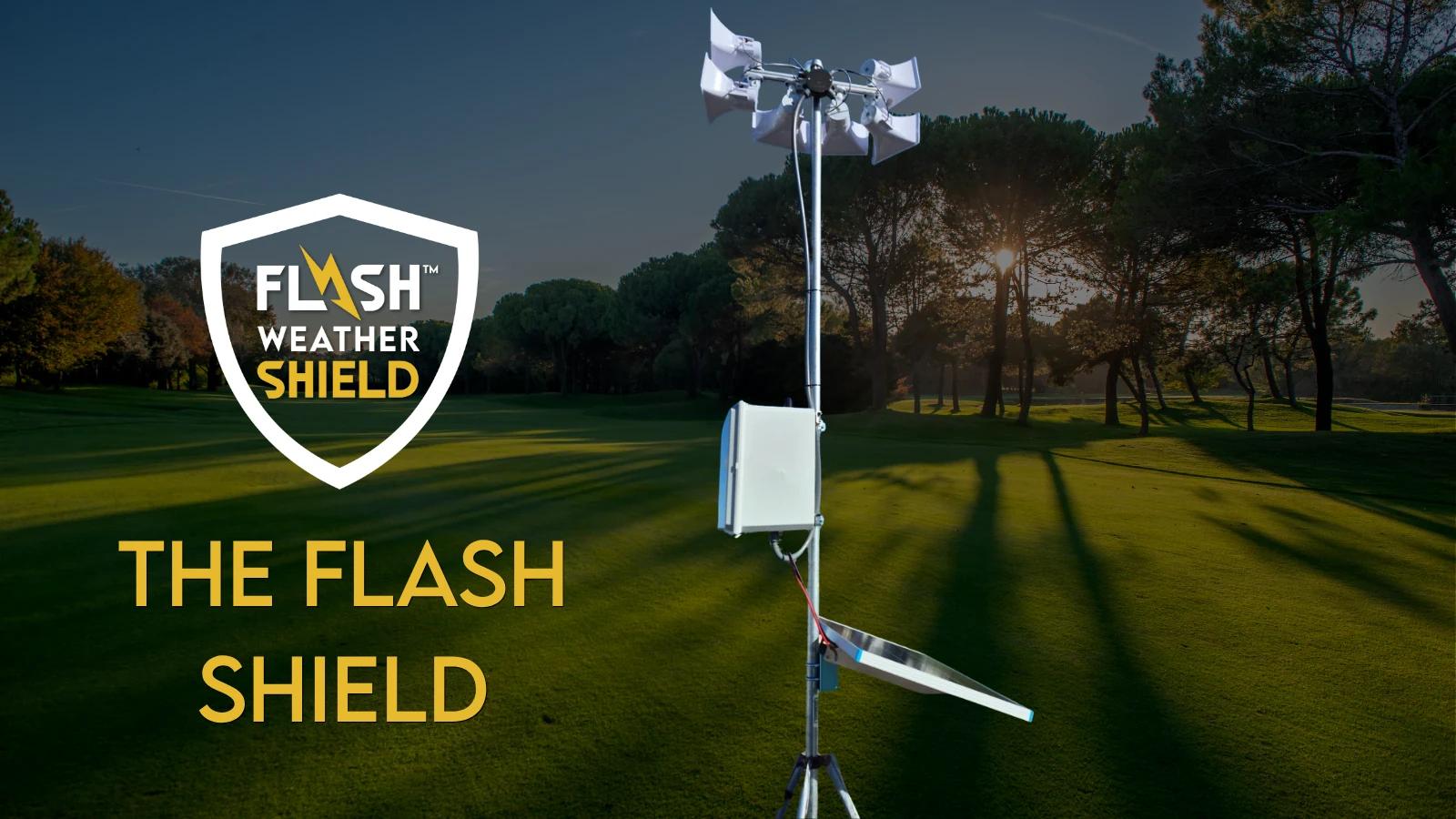
Flash Weather Shield
A siren that sounds on the forecast, for sites that want one.
Sferic Siren vs Flash, side by side
| Attribute | AEM Sferic Siren | Flash |
|---|---|---|
| What triggers the alert | Lightning detected by the Earth Networks Total Lightning Network inside your radius | A forecast for your 1×1 km cell, up to 60 minutes before the first strike |
| Lightning types | In-cloud and cloud-to-ground detection | Forecasts cloud-to-ground strikes; detected strikes on the map |
| All-clear | Distinct all-clear tone and countdown display | All-clear timer after the last strike |
| On site | 117 dB horn and strobes; voice and wall-mounted options; solar option | No hardware required; relays for existing horns, or Flash Weather Shield |
| Other channels | Text, email and mobile app | Web app, mobile app, SMS and email |
| Pricing | Not published on the page we checked | Per site, annual, quoted after a demo; free app tier for individuals |
AEM Sferic Siren
- What triggers the alert
- Lightning detected by the Earth Networks Total Lightning Network inside your radius
- Lightning types
- In-cloud and cloud-to-ground detection
- All-clear
- Distinct all-clear tone and countdown display
- On site
- 117 dB horn and strobes; voice and wall-mounted options; solar option
- Other channels
- Text, email and mobile app
- Pricing
- Not published on the page we checked
Flash
- What triggers the alert
- A forecast for your 1×1 km cell, up to 60 minutes before the first strike
- Lightning types
- Forecasts cloud-to-ground strikes; detected strikes on the map
- All-clear
- All-clear timer after the last strike
- On site
- No hardware required; relays for existing horns, or Flash Weather Shield
- Other channels
- Web app, mobile app, SMS and email
- Pricing
- Per site, annual, quoted after a demo; free app tier for individuals
When the Sferic Siren is the better fit
- Your policy is written around a detected-lightning radius and you want a loud, self-contained horn that enforces it with no one in the loop.
- You want total lightning detection, including in-cloud flashes, behind your siren.
- You need hardware with battery backup for sites where power is unreliable.
When Flash is the better fit
- You want to start clearing a course or a complex before lightning is in range, with a time attached to the call.
- You manage many sites and would rather not install and maintain a siren at every one.
- You want to check the accuracy behind the alert against a published method.
Flash is a Preferred Vendor Partner across all 700+ Troon golf properties and the official weather safety provider of the Big 12 Conference.
Running both
If a Sferic Siren is already on your property, keep it. It confirms lightning in range and enforces the all-clear on site. Flash adds the hour before, on the phones of the people who make the call. The everyone else vs Flash comparison explains how detection and prediction fit in one plan.
Frequently asked
As AEM describes it on 15 Oct 2026, the system sounds when the Earth Networks Total Lightning Network detects lightning inside your configured radius, and it detects in-cloud lightning as well as cloud-to-ground. Flash forecasts the likelihood of a cloud-to-ground strike per 1×1 km cell for the next 60 minutes.
AEM refers to the Earth Networks Total Lightning Network as its own, and sells the Sferic Siren lightning alert system on aem.eco.
Flash drives horns and strobes through relays. Whether an existing siren can take a relay input depends on the unit, so check with its vendor before you plan on it.